Skip to Content

Stainless Steel Vacuum Chamber

https://www.s4r.fr/web/image/product.template/320/image_1920?unique=3fd657d

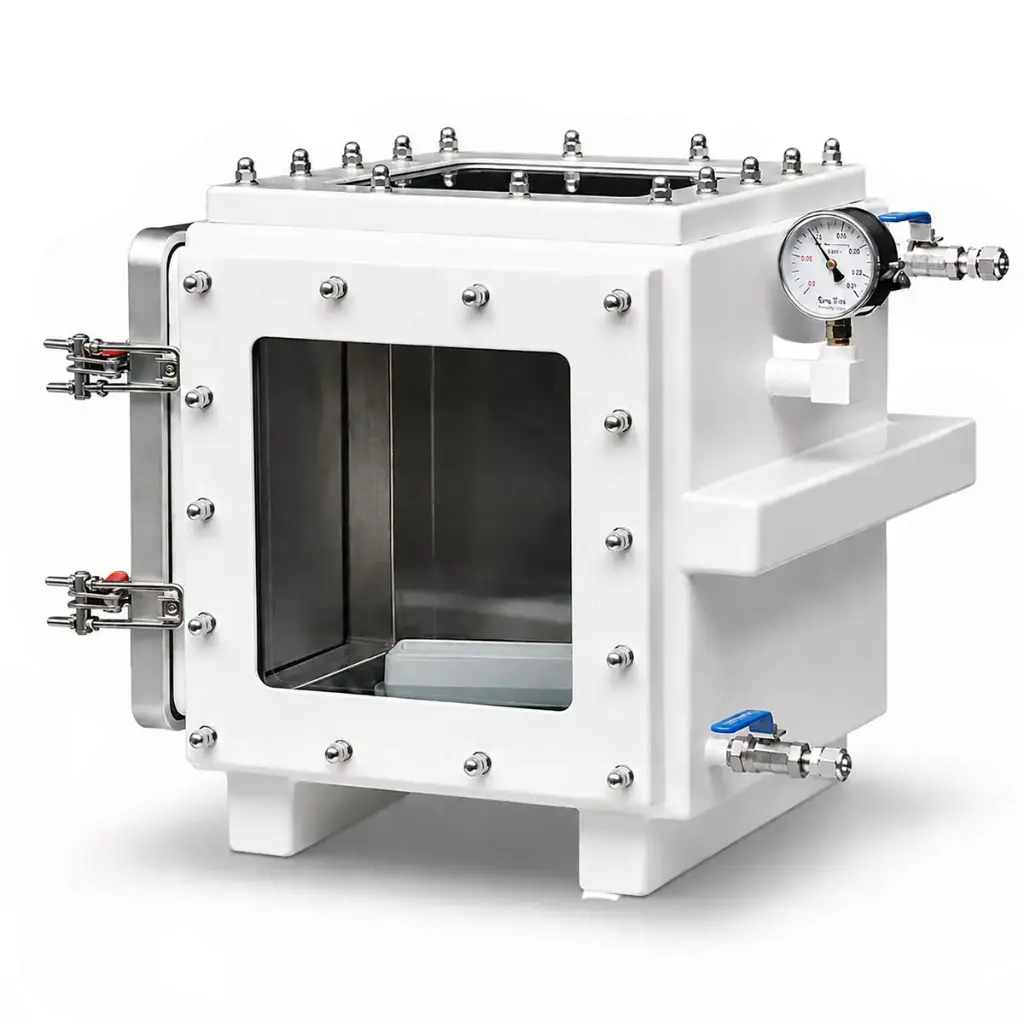
The S4R Stainless Steel Vacuum Chamber is designed for laboratory processes requiring a robust, observable environment under controlled negative pressure. Its 304 stainless-steel enclosure provides greater mechanical durability and broader process compatibility than an acrylic chamber, while tempered-glass viewing windows allow the experiment to remain visible during evacuation and vacuum holding.

The chamber is manufactured from 3 mm stainless steel and incorporates external structural reinforcement for routine operation down to a specified gauge vacuum of −0.1 MPa. A chamber-mounted vacuum gauge provides direct pressure indication, while manual valve connections allow evacuation, isolation, controlled venting and inert-gas backfilling from an external supply.

Two standard chamber sizes are available: 400 × 400 × 400 mm for general laboratory use and 600 × 600 × 600 mm for larger vessels, fixtures and experimental assemblies.

Typical applications include vacuum degassing, vacuum-assisted drying and conditioning, materials and battery research, component testing, vacuum encapsulation and laboratory processes involving samples that require temporary vacuum or inert-atmosphere handling.

The chamber is intended for rough-vacuum processing. It is not a high-vacuum chamber and does not incorporate continuous gas purification or ppm-level H₂O/O₂ control.

0.00 € 0.0 EUR 0.00 €

Pricing available to approved customers

Sign in to view your pricing, or request access to an S4R professional account.

  • Chamber Size

This combination does not exist.

Request Pricing Access
Laboratory Vacuum Processing

Stainless Steel Vacuum Chamber

Robust 304 stainless-steel chamber for controlled evacuation, vacuum holding and laboratory processing

The chamber provides a durable, observable environment for laboratory operations requiring controlled negative pressure. The 304 stainless-steel enclosure combines mechanical robustness with tempered-glass viewing windows, so samples, vessels and experimental assemblies remain visible without opening the chamber.

The 3 mm construction incorporates external reinforcing ribs to increase structural rigidity during vacuum operation. A chamber-mounted gauge and manual valve connections give direct control of evacuation, isolation, venting and, where the protocol requires it, backfilling with a compatible inert gas from an external supply.

Standard sizes
400 & 600 mm
Chamber material
304 stainless steel
Gauge vacuum
Down to −0.1 MPa
Leakage rate
≤ 0.001 vol%/h
Product Highlights

A durable platform for controlled vacuum processing

For laboratory processes that call for the robustness of stainless steel, direct visual monitoring and straightforward manual vacuum operation.

01

Ribbed 304 enclosure

A 3 mm stainless-steel chamber with external reinforcing ribs that increase structural rigidity during vacuum operation.

02

Multiple viewing windows

Tempered-glass windows keep the process under observation from several angles without breaking vacuum.

03

Manual vacuum control

A chamber-mounted gauge and valve interface support evacuation, isolation, controlled venting and external gas introduction.

04

Two sizes, custom builds

Two standard configurations, with temperature control, automatic pressure control and non-standard chambers available on request.

Operating Principle

Pump down, hold, backfill and vent

The chamber works by removing the internal atmosphere with an external vacuum pump. The sequence adapts to vacuum-holding or vacuum/backfill procedures according to the experimental requirement.

01
Evacuation

Pump down the chamber

Load the samples or experimental assembly, close the chamber and run the external pump until the pressure required by the procedure is reached.

02
Holding

Isolate and hold

Close the vacuum valve and stop the pump. Pressure may drift slightly through residual leakage or evaporation from the load, so monitor the gauge over the holding period.

03
Backfill

Introduce inert gas if required

Where the protocol calls for an inert environment, admit a compatible gas from an external supply through the dedicated valve connection.

04
Recovery

Vent before opening

Return the chamber progressively to atmospheric pressure through the vent connection, then open the enclosure and recover the samples.

Construction & Vacuum Interface

Stainless-steel construction with direct process visibility

A reinforced 304 stainless-steel enclosure combined with tempered-glass viewing windows and chamber-mounted vacuum instrumentation.

Enclosure

304 stainless steel

3 mm construction with external reinforcing ribs for routine laboratory vacuum use.

Observation

Tempered-glass windows

Several viewing windows give visual access to the working volume during operation.

Monitoring

Local vacuum gauge

Chamber-mounted indication for reading pressure during pump-down and holding.

Control

Manual valve interface

Connections for evacuation and isolation, and for venting or compatible gas introduction.

Model Selection

Two sizes for laboratory-scale vacuum workflows

Both configurations share the same materials, construction, vacuum interface and specified performance. Only the chamber size differs.

S4R-SVC-400
400 × 400 × 400 mm

Compact general-purpose configuration for routine benchtop procedures, sample conditioning and small experimental assemblies.

S4R-SVC-600
600 × 600 × 600 mm

Larger working volume for bulkier vessels, fixtures and multi-component experimental assemblies, or for processing several items per cycle.

Stainless steel or acrylic S4R also supplies a fully transparent acrylic chamber in smaller sizes. Choose stainless steel for mechanical robustness, broader chemical compatibility and temperature-controlled configurations; choose acrylic when unobstructed observation on every face is the priority and the process is compatible with the material.
Nominal chamber dimensions The values above identify the two standard main-chamber configurations. Overall equipment dimensions are larger, since they include the reinforcing structure, viewing windows, gauge, valves and external fittings. Confirm the internal working dimensions and the bench footprint with S4R before ordering.
Product Data

Technical specifications

Characteristics common to both configurations.

Parameter Specification
Product type Stainless-steel laboratory vacuum chamber
Standard configurations S4R-SVC-400 and S4R-SVC-600
Chamber material 304 stainless steel
Wall thickness 3 mm
Construction Enclosure with external reinforcing ribs
Viewing system Multiple tempered-glass windows
Gauge vacuum Down to −0.1 MPa
Leakage rate ≤ 0.001 vol%/h
Pressure indication Chamber-mounted vacuum gauge
Evacuation source External vacuum pump
Vacuum isolation Manual valve on the vacuum line
Venting and gas introduction Manual valve; inert-gas backfill from an external compatible supply
Operating mode Negative-pressure operation
Vacuum pump Available as an option
Automatic control system Available as an option
Temperature control High- or low-temperature systems available as a custom configuration
Custom configuration Non-standard chamber sizes and process integration on request
Typical Applications

Vacuum processing for research, conditioning and testing

Suited to laboratory workflows that need a robust and observable reduced-pressure environment.

Materials and battery research

Vacuum conditioning and preparation of compatible electrodes, powders, components and experimental materials.

Electronics and semiconductors

Vacuum encapsulation and leak-testing operations on compatible electronic components and semiconductor devices.

Vacuum degassing

Removal of trapped air from compatible liquids, slurries, resins and other formulations before further processing.

Vacuum drying and conditioning

Reduced-pressure treatment of compatible materials where vacuum-assisted removal of moisture or volatile species is required.

Component and process testing

Laboratory testing, conditioning and assembly procedures requiring a controlled negative-pressure environment.

Standard Configuration

Core chamber configuration

The standard configuration brings together the principal chamber, viewing and vacuum-control elements required for manual laboratory operation.

Chamber

304 stainless-steel enclosure

Reinforced 3 mm chamber construction in the selected SVC-400 or SVC-600 configuration.

Observation

Tempered-glass windows

Viewing windows integrated into the chamber walls.

Vacuum interface

Gauge and valve assembly

Chamber-mounted pressure indication and manual connections for evacuation, isolation, venting and compatible gas introduction.

Optional equipment Vacuum pumps, automatic pressure-control systems and temperature-controlled configurations are available according to the required laboratory workflow.
Rough vacuum — not a high-vacuum chamber This chamber is intended for laboratory rough-vacuum processing. It should not be specified for high-vacuum work requiring high-vacuum flanges, turbomolecular pumping or pressures substantially below the stated operating range. The standard chamber is specified for negative-pressure operation; positive-pressure use is not rated.
Not a purification glove box The chamber supports vacuum/backfill procedures using an external compatible gas supply, but has no continuous gas recirculation, oxygen removal or moisture purification, and therefore does not deliver ppm-level H₂O or O₂ control.
Vacuum performance The −0.1 MPa figure is a gauge pressure, read on the chamber gauge relative to atmosphere. The pressure actually reached, and the time needed to reach it, depend on the pump, the vacuum circuit, the chamber closure and the condition of the sealing interfaces. Contact S4R if your protocol requires an ultimate pressure expressed in absolute units.
Process compatibility 304 stainless steel offers broader process compatibility than acrylic, but the viewing windows, the seals and the complete vacuum circuit should still be reviewed for aggressive chemicals, elevated temperatures or unusual process conditions. Contact S4R with the intended chemistry and temperature range before ordering.

Our latest content

Check out what's new in our company !

Your Dynamic Snippet will be displayed here... This message is displayed because you did not provide both a filter and a template to use.