- All Products
- Measurement & Characterization
- S4R InertBridge™ — Vacuum Transfer Chamber for Air-Sensitive SEM Samples
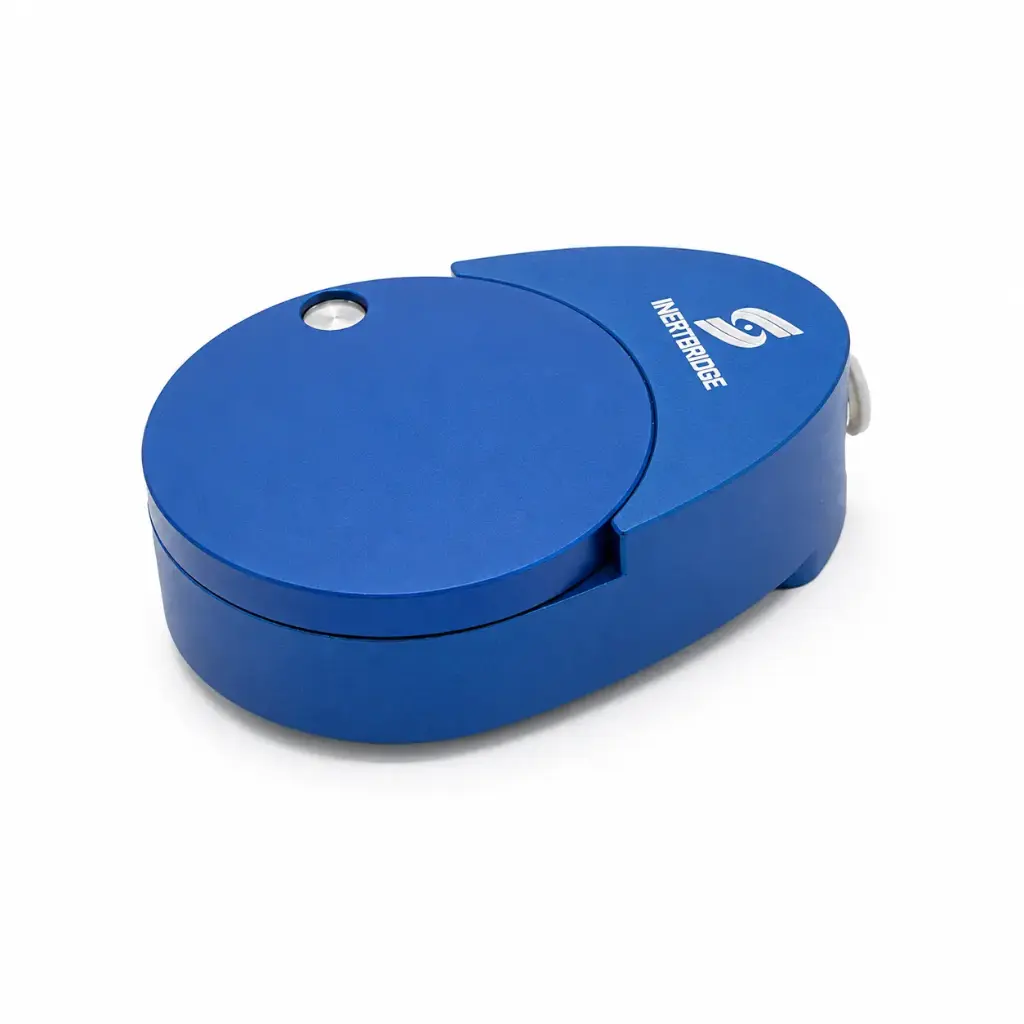
S4R InertBridge™ — Vacuum Transfer Chamber for Air-Sensitive SEM Samples
https://www.s4r.fr/shop/s4r-lbe-lmc0001a-s4r-inertbridgetm-vacuum-transfer-chamber-for-air-sensitive-sem-samples-204 https://www.s4r.fr/web/image/product.template/204/image_1920?unique=cff4d79The S4R InertBridge™ is a compact vacuum transfer chamber developed for the protected transfer of air-sensitive samples from a glovebox to a scanning electron microscope. Samples remain enclosed within an evacuated compartment during handling and transport, limiting their exposure to ambient oxygen, moisture, and laboratory contamination.
The chamber is evacuated and closed inside the glovebox. Under ambient conditions, the pressure differential across the cover maintains contact with the sealing interface. Once the InertBridge™ is installed inside the SEM and the microscope chamber is pumped down, the external pressure progressively decreases. When the resulting closing force becomes lower than the force exerted by the integrated spring mechanism, the cover moves laterally to expose the samples for observation.
The standard sample holder provides four Ø8 mm positions with a nominal position geometry of Ø8 × 0.5 mm. Alternative sample-holder geometries can be configured according to the intended samples and experimental workflow. A machine-specific SEM mounting adapter is included, with configurations available for selected ZEISS, JEOL, and Thermo Scientific platforms, as well as other microscope models following compatibility review.
No account required. Add the products you need, then send your request to our technical sales team.
Request Pricing AccessAlready have an approved account? Sign in
S4R InertBridge™
The S4R InertBridge™ is a compact vacuum transfer chamber developed for the protected transfer of air-sensitive samples from a glovebox to a scanning electron microscope.
A pressure-differential retention mechanism holds the cover against the sealing interface during handling and transport, while an integrated spring drives its lateral opening during SEM pump-down.
Protected transfer through a compact pressure-responsive system
Designed to limit atmospheric exposure between controlled sample preparation in a glovebox and observation inside a scanning electron microscope.
Protected transfer
Keeps air-sensitive samples inside an evacuated compartment during transfer from the glovebox to the SEM.
Pressure-differential retention
The pressure difference between the evacuated compartment and the ambient atmosphere presses the cover against the sealing interface.
Passive spring-driven opening
SEM pump-down reduces the pressure-dependent retaining resistance until the spring preload overcomes it and drives the cover laterally. No powered actuator is required in the chamber.
Configurable integration
Model-specific mounting adapters and alternative sample-holder geometries can be configured for the intended experimental setup.
From glovebox preparation to sample recovery
Seven defined steps, from sample preparation under controlled atmosphere to retrieval of the holder after imaging.
Sample preparation
Prepare and position the samples in the four-position holder under the required controlled-atmosphere conditions.
Chamber loading
Insert the loaded holder into the sample compartment and place the cover in its closing position.
Evacuation and closure
Evacuate the compartment through the vacuum connection. The resulting pressure differential holds the cover against the sealing interface.
Glovebox-to-SEM transfer
Remove the closed chamber from the glovebox and carry it to the microscope. The compartment remains sealed throughout handling.
SEM installation
Install the chamber in the microscope using the dedicated model-specific mounting adapter.
Pump-down and opening
As chamber pressure decreases, the pressure-dependent retaining resistance diminishes until the spring preload overcomes it and drives the cover laterally to expose the samples.
Sample recovery
The cover remains in its open position after the analysis. Once the microscope is vented, the sample holder is retrieved directly from the chamber. The protected transfer applies to the route towards the microscope; the return path is carried out under laboratory atmosphere.
Passive release during SEM chamber evacuation
During transport at ambient laboratory pressure, the pressure outside the evacuated compartment is higher than the pressure inside it. The pressure difference across the cover produces a normal force that presses it against the sealing interface. The resulting contact resistance opposes the lateral preload of the integrated spring.
As the SEM chamber is evacuated, the external pressure decreases, the normal force across the cover falls and the retaining resistance decreases with it. Once the spring preload exceeds that resistance, the cover is released and travels laterally to expose the samples.
Four-position holder with configurable recess geometry
The standard holder is machined from 316 stainless steel and incorporates four cylindrical sample recesses, each with a nominal diameter of Ø 8 mm and a nominal depth of 0.5 mm.
Because the intended specimens are solid, recess diameter and depth are the governing dimensional specifications. Alternative layouts can be evaluated according to the sample geometry and the analytical workflow.
Materials and vacuum interface
Machined construction combining an anodised aluminium body with a stainless steel sample holder and a user-replaceable sealing element.
Machined body and cover, anodised for surface protection.
Four cylindrical recesses, Ø 8 mm × 0.5 mm deep.
Replaceable by the user without returning the chamber.
Accepts tubing of 8 mm outside diameter for evacuation.
Model-specific integration across SEM platforms
The chamber is installed inside the microscope through a dedicated mounting adapter configured for the specified SEM model. One compatible adapter is included according to the selected product configuration.
Configured platforms
Adapter configurations are available for selected ZEISS, JEOL and Thermo Scientific SEM models.
Other platforms
Custom integration is evaluated according to the mechanical interface, chamber clearance, stage geometry and cover-opening envelope.
SEM characterisation of air- and moisture-sensitive materials
Intended for mounted samples whose surface chemistry, morphology or analytical response may be altered by exposure to ambient oxygen or moisture.
Battery materials and interfaces
Prepared electrodes, interfacial cross sections and other mounted battery materials for SEM imaging and compatible microanalysis.
Solid electrolytes
Moisture-sensitive or reactive solid-electrolyte materials following preparation under controlled atmosphere.
Air-sensitive functional materials
Mounted functional materials whose surfaces may oxidise, hydrate or otherwise change rapidly when exposed to laboratory air.
Powders, thin films and cross sections
Secured powder specimens, crystals, thin films and cross sections prepared under controlled atmosphere.
Compact geometry for SEM chamber integration
Refer to the dimensional drawing for the external envelope, the mounting interface, the sample position and the lateral cover-opening clearance.
Technical specifications
Standard configuration of the transfer chamber.
| Parameter | Specification |
|---|---|
| Product type | Vacuum transfer chamber for air-sensitive samples intended for SEM analysis |
| Transfer route | Glovebox to scanning electron microscope |
| Protection principle | Transfer inside an evacuated, closed sample compartment |
| Closure principle | Pressure-differential retention against the sealing interface |
| Opening principle | Pressure-dependent retaining resistance decreases during SEM pump-down; spring-driven lateral opening without a powered in-chamber actuator |
| Chamber material | Anodised aluminium |
| Sample-holder material | 316 stainless steel |
| Sealing element | Silicone O-ring, replaceable by the user |
| Vacuum connection | Quick connector for tubing of Ø 8 mm outside diameter |
| Standard sample holder | 4 positions, cylindrical recesses of Ø 8 mm × 0.5 mm deep |
| Custom sample holder | Alternative geometries available on request |
| Nominal chamber mass | 200 g |
| External dimensions | Refer to the dimensional drawing |
| SEM mounting | Model-specific adapter; one compatible adapter included according to the selected configuration |
| Configured platforms | Selected ZEISS, JEOL and Thermo Scientific SEM models; exact model confirmation required |
| Other platforms | Custom integration available following compatibility review |
| Positioning stand | Included |
| Vacuum pump | Available as an option |
Included components
S4R InertBridge™
The S4R InertBridge™ is a compact vacuum transfer chamber developed for the protected transfer of air-sensitive samples from a glovebox to a scanning electron microscope.
A pressure-differential retention mechanism holds the cover against the sealing interface during handling and transport, while an integrated spring drives its lateral opening during SEM pump-down.
Protected transfer through a compact pressure-responsive system
Designed to limit atmospheric exposure between controlled sample preparation in a glovebox and observation inside a scanning electron microscope.
Protected transfer
Keeps air-sensitive samples inside an evacuated compartment during transfer from the glovebox to the SEM.
Pressure-differential retention
The pressure difference between the evacuated compartment and the ambient atmosphere presses the cover against the sealing interface.
Passive spring-driven opening
SEM pump-down reduces the pressure-dependent retaining resistance until the spring preload overcomes it and drives the cover laterally. No powered actuator is required in the chamber.
Configurable integration
Model-specific mounting adapters and alternative sample-holder geometries can be configured for the intended experimental setup.
From glovebox preparation to sample recovery
Seven defined steps, from sample preparation under controlled atmosphere to retrieval of the holder after imaging.
Sample preparation
Prepare and position the samples in the four-position holder under the required controlled-atmosphere conditions.
Chamber loading
Insert the loaded holder into the sample compartment and place the cover in its closing position.
Evacuation and closure
Evacuate the compartment through the vacuum connection. The resulting pressure differential holds the cover against the sealing interface.
Glovebox-to-SEM transfer
Remove the closed chamber from the glovebox and carry it to the microscope. The compartment remains sealed throughout handling.
SEM installation
Install the chamber in the microscope using the dedicated model-specific mounting adapter.
Pump-down and opening
As chamber pressure decreases, the pressure-dependent retaining resistance diminishes until the spring preload overcomes it and drives the cover laterally to expose the samples.
Sample recovery
The cover remains in its open position after the analysis. Once the microscope is vented, the sample holder is retrieved directly from the chamber. The protected transfer applies to the route towards the microscope; the return path is carried out under laboratory atmosphere.
Passive release during SEM chamber evacuation
During transport at ambient laboratory pressure, the pressure outside the evacuated compartment is higher than the pressure inside it. The pressure difference across the cover produces a normal force that presses it against the sealing interface. The resulting contact resistance opposes the lateral preload of the integrated spring.
As the SEM chamber is evacuated, the external pressure decreases, the normal force across the cover falls and the retaining resistance decreases with it. Once the spring preload exceeds that resistance, the cover is released and travels laterally to expose the samples.
Four-position holder with configurable recess geometry
The standard holder is machined from 316 stainless steel and incorporates four cylindrical sample recesses, each with a nominal diameter of Ø 8 mm and a nominal depth of 0.5 mm.
Because the intended specimens are solid, recess diameter and depth are the governing dimensional specifications. Alternative layouts can be evaluated according to the sample geometry and the analytical workflow.
Materials and vacuum interface
Machined construction combining an anodised aluminium body with a stainless steel sample holder and a user-replaceable sealing element.
Machined body and cover, anodised for surface protection.
Four cylindrical recesses, Ø 8 mm × 0.5 mm deep.
Replaceable by the user without returning the chamber.
Accepts tubing of 8 mm outside diameter for evacuation.
Model-specific integration across SEM platforms
The chamber is installed inside the microscope through a dedicated mounting adapter configured for the specified SEM model. One compatible adapter is included according to the selected product configuration.
Configured platforms
Adapter configurations are available for selected ZEISS, JEOL and Thermo Scientific SEM models.
Other platforms
Custom integration is evaluated according to the mechanical interface, chamber clearance, stage geometry and cover-opening envelope.
SEM characterisation of air- and moisture-sensitive materials
Intended for mounted samples whose surface chemistry, morphology or analytical response may be altered by exposure to ambient oxygen or moisture.
Battery materials and interfaces
Prepared electrodes, interfacial cross sections and other mounted battery materials for SEM imaging and compatible microanalysis.
Solid electrolytes
Moisture-sensitive or reactive solid-electrolyte materials following preparation under controlled atmosphere.
Air-sensitive functional materials
Mounted functional materials whose surfaces may oxidise, hydrate or otherwise change rapidly when exposed to laboratory air.
Powders, thin films and cross sections
Secured powder specimens, crystals, thin films and cross sections prepared under controlled atmosphere.
Compact geometry for SEM chamber integration
Refer to the dimensional drawing for the external envelope, the mounting interface, the sample position and the lateral cover-opening clearance.
Technical specifications
Standard configuration of the transfer chamber.
| Parameter | Specification |
|---|---|
| Product type | Vacuum transfer chamber for air-sensitive samples intended for SEM analysis |
| Transfer route | Glovebox to scanning electron microscope |
| Protection principle | Transfer inside an evacuated, closed sample compartment |
| Closure principle | Pressure-differential retention against the sealing interface |
| Opening principle | Pressure-dependent retaining resistance decreases during SEM pump-down; spring-driven lateral opening without a powered in-chamber actuator |
| Chamber material | Anodised aluminium |
| Sample-holder material | 316 stainless steel |
| Sealing element | Silicone O-ring, replaceable by the user |
| Vacuum connection | Quick connector for tubing of Ø 8 mm outside diameter |
| Standard sample holder | 4 positions, cylindrical recesses of Ø 8 mm × 0.5 mm deep |
| Custom sample holder | Alternative geometries available on request |
| Nominal chamber mass | 200 g |
| External dimensions | Refer to the dimensional drawing |
| SEM mounting | Model-specific adapter; one compatible adapter included according to the selected configuration |
| Configured platforms | Selected ZEISS, JEOL and Thermo Scientific SEM models; exact model confirmation required |
| Other platforms | Custom integration available following compatibility review |
| Positioning stand | Included |
| Vacuum pump | Available as an option |
Included components
Our latest content
Check out what's new in our company !