- All Products
- All Products
- S4R SolidScan™ R — Operando Raman Cell
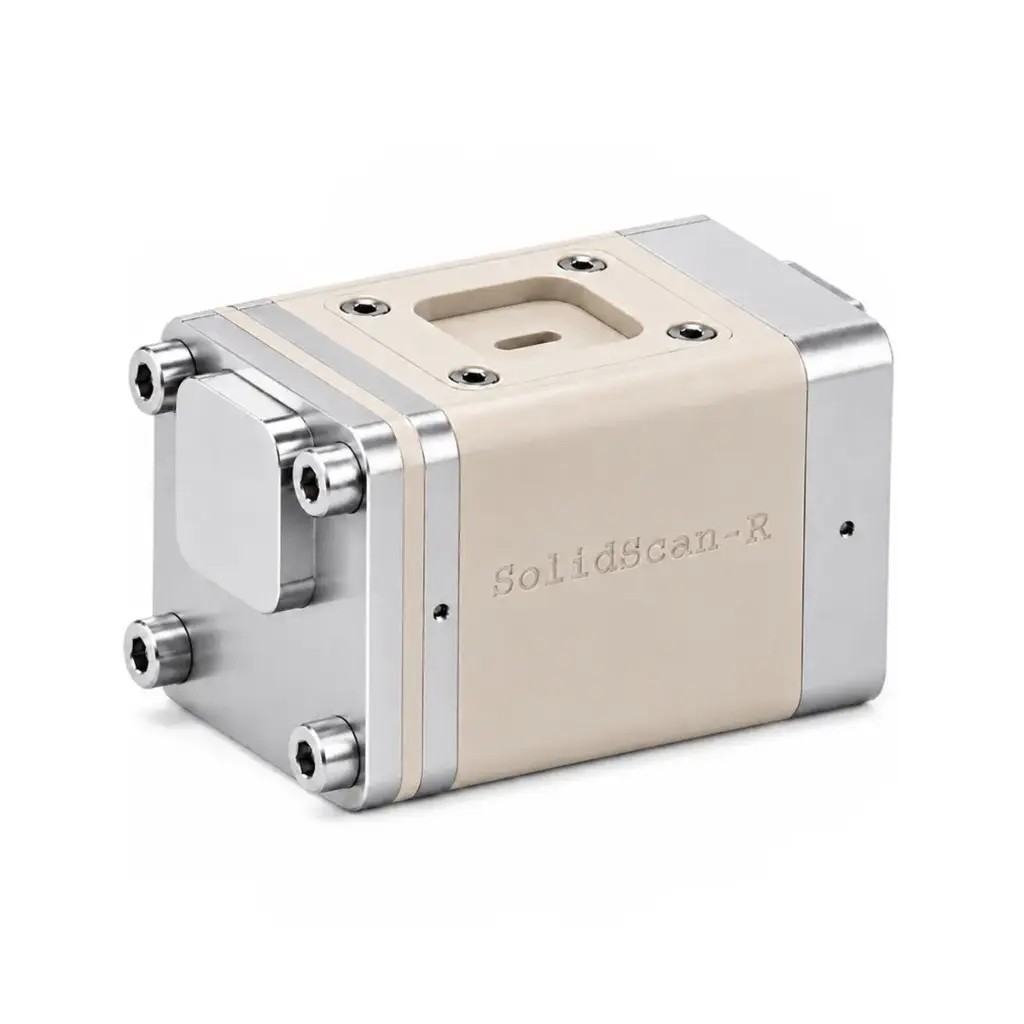
S4R SolidScan™ R — Operando Raman Cell
https://www.s4r.fr/shop/s4r-bat-ssb0003a-s4r-solidscantm-r-operando-raman-cell-312 https://www.s4r.fr/web/image/product.template/312/image_1920?unique=cff4d79The S4R SolidScan™ R is a compact sealed compression cell developed for in situ and operando Raman characterization of all-solid-state battery materials, interfaces, and complete electrochemical stacks.
Unlike conventional optical cells designed around pre-formed samples, the SolidScan™ R enables the battery stack to be built and compacted directly inside the final characterization cell. Solid-electrolyte and electrode layers can be introduced sequentially and compressed using an external laboratory press. The completed assembly is then mechanically secured, providing a compact platform for subsequent electrochemical and Raman measurements.
The cell combines opposed compression plungers with an 8.00 mm-wide D-shaped compression profile, hardened stainless steel 410, hard chromium surface protection, PEEK electrical insulation, static silicone O-ring sealing, and an independent removable sapphire optical module. The Raman optical axis is arranged orthogonally to the primary compression axis, allowing spectroscopic access to the electrochemical stack while preserving the mechanically confined cell architecture.
The complete SolidScan™ R measures 85 × 50 × 50 mm, has a nominal mass of 800 g, and supports nominal preparatory pressures of up to 400 MPa using an external laboratory press. For air- or moisture-sensitive materials, the complete cell can be prepared and sealed inside a glovebox before transfer to external Raman and electrochemical instrumentation.
No account required. Add the products you need, then send your request to our technical sales team.
Request Pricing AccessAlready have an approved account? Sign in
S4R SolidScan™ R
The S4R SolidScan™ R is a compact sealed compression cell developed for in situ and operando Raman characterisation of all-solid-state battery materials, interfaces, and complete electrochemical stacks.
The electrochemical stack is formed directly inside the final cell using an external laboratory press. Solid-electrolyte and electrode layers can be introduced and compacted sequentially along the compression axis between the two opposed plungers before the complete assembly is mechanically secured for subsequent electrochemical and Raman characterisation.
From powder compaction to operando Raman analysis
A single compact platform for controlled all-solid-state battery preparation, electrochemical testing, and optical characterisation.
Cross-section observation without dismantling the electrochemical stack
Raman spectroscopy can provide molecular and structural information on active materials, solid electrolytes, reaction products, phase evolution, and interfacial chemistry during electrochemical operation.
In the SolidScan™ R, the two opposed plungers define the primary compression axis of the battery stack. The Raman optical axis passes through the sapphire-window module and is arranged orthogonally to the primary compression axis.
This geometry provides spectroscopic access to the cross-section of the working electrode, solid electrolyte, counter electrode, and the interfaces between these layers while preserving the compact, mechanically confined electrochemical assembly.
Build and compact the battery directly inside the measurement cell
The SolidScan™ R is designed so that the electrochemical stack can be prepared directly between the opposed plungers instead of transferring a separately pressed pellet into another characterisation holder.
During press formation, the cell is oriented so that the opposed-plunger axis is aligned with the loading axis of the external laboratory press. The successive battery layers are therefore formed and compacted along the compression axis between the two plungers.
Opposed compression with orthogonal Raman access
Two opposed plungers transmit the load supplied by the external laboratory press to the all-solid-state battery stack and define its primary compression axis.
For Raman characterisation, the optical axis passes through the sapphire-window module and is arranged orthogonally to the compression axis. This provides direct observation of the stack cross-section rather than only an external electrode surface.
After stack preparation, the integrated fastening system mechanically secures the complete cell assembly for handling, electrochemical measurement, and Raman characterisation.
Independent removable sapphire-window assembly
The Raman optical module incorporates a sapphire window providing spectroscopic access to the cross-section of the electrochemical stack while maintaining the enclosed cell architecture required for sensitive solid-state battery materials.
The complete optical module is mechanically independent and removable, simplifying inspection, cleaning, routine maintenance, and optical-window replacement.
Hardened stainless steel 410 with PEEK insulation
The principal metallic load-bearing components and compression plungers are manufactured from hardened stainless steel 410 to provide the rigidity required for high-pressure solid-state battery preparation.
Hard chromium surface treatment improves surface hardness and wear resistance during repeated press-forming, assembly, disassembly, and cleaning. Dedicated PEEK components provide electrical insulation and mechanical separation between conductive sections of the cell.
Static silicone O-rings provide sealing between the principal cell components when correctly installed. The sealed architecture is designed for transfer between controlled-atmosphere preparation and external characterisation equipment.
Integrated 2 mm banana plug connections
The two principal electrode sections incorporate Ø2 mm electrical connection holes compatible with standard 2 mm banana plugs.
The SolidScan™ R can therefore be connected directly to compatible battery cyclers, potentiostats, impedance analysers, and other electrochemical measurement systems.
High-pressure stack preparation up to 400 MPa
Preparation pressure is generated by an external laboratory press and calculated from the force applied to the nominal D-shaped compressed area.
| Nominal Pressure | Applied Force | Approximate Load |
|---|---|---|
| 100 MPa | 5.71 kN | 0.58 tf |
| 200 MPa | 11.43 kN | 1.17 tf |
| 300 MPa | 17.14 kN | 1.75 tf |
| 400 MPa | 22.85 kN | 2.33 tf |
Prepare inside the glovebox, characterise outside
Air- and moisture-sensitive materials can be loaded, compacted, assembled, and sealed inside an appropriate glovebox or controlled atmosphere.
Once assembly is complete, the SolidScan™ R forms a compact, self-contained test cell designed for transfer to external Raman spectroscopy and electrochemical characterisation equipment.
The electrochemical stack remains enclosed during transfer, allowing the cell to move directly from controlled-atmosphere preparation to operando Raman spectroscopy and cycling without reopening the assembly.
Advanced Raman characterisation of all-solid-state batteries
Designed for studies correlating electrochemical operation with Raman-observable structural and chemical evolution.
Compact 85 × 50 × 50 mm construction
The complete SolidScan™ R has nominal external dimensions of 85 × 50 × 50 mm and a nominal mass of 800 g.
S4R SolidScan™ R Specifications
| Parameter | Specification |
|---|---|
| Product Type | Operando Raman compression cell for all-solid-state batteries |
| Electrochemical Configuration | Two-electrode all-solid-state battery configuration |
| Compression Architecture | Two opposed compression plungers |
| Compression Profile | D-shaped profile: 8.00 mm width, 4.00 mm straight section, and one semicircular Ø8.00 mm end |
| Nominal Compressed Area | 57.13 mm² |
| Press Formation Orientation | Opposed-plunger axis aligned with the loading axis of the external laboratory press |
| Metallic Material | Hardened stainless steel 410 |
| Surface Treatment | Hard chromium coating |
| Electrical Insulation | PEEK |
| Static Sealing | Silicone O-rings |
| Optical Window Material | Sapphire |
| Optical Module | Independent removable Raman optical module |
| Optical Orientation | Raman optical axis orthogonal to the primary compression axis |
| Raman Observation Geometry | Cross-section observation of the compressed electrochemical stack |
| Optical Interface Details | Clear aperture, window thickness, and objective working-distance guidance available from S4R on request |
| Electrical Connections | 2 × Ø2 mm connection holes for 2 mm banana plugs |
| Stack Preparation | Sequential material loading and compaction along the compression axis between the two opposed plungers |
| Stack Thickness Compatibility | Configuration-dependent; dimensional guidance available from S4R on request |
| Preparatory Pressure Application | External laboratory press |
| Maximum Nominal Preparatory Pressure | Up to 400 MPa* |
| Force at 400 MPa | 22.85 kN, approximately 2.33 tf |
| External Dimensions | 85 × 50 × 50 mm |
| Nominal Cell Mass | 800 g |
| Maximum Cell Temperature | Up to 120 °C with appropriate external temperature-control equipment |
| Integrated Heating | No |
| Glovebox Assembly | Compatible |
| External Transfer | Designed for transfer after complete sealed assembly |
| Construction | Fully disassemblable for sample loading, cleaning, maintenance, and optical-window servicing |
Complete SolidScan™ R cell assembly
The SolidScan™ R is supplied as a complete characterisation cell with the principal components required for routine assembly, electrical connection, sealing, and Raman operation.
S4R SolidScan™ R
The S4R SolidScan™ R is a compact sealed compression cell developed for in situ and operando Raman characterisation of all-solid-state battery materials, interfaces, and complete electrochemical stacks.
The electrochemical stack is formed directly inside the final cell using an external laboratory press. Solid-electrolyte and electrode layers can be introduced and compacted sequentially along the compression axis between the two opposed plungers before the complete assembly is mechanically secured for subsequent electrochemical and Raman characterisation.
From powder compaction to operando Raman analysis
A single compact platform for controlled all-solid-state battery preparation, electrochemical testing, and optical characterisation.
Cross-section observation without dismantling the electrochemical stack
Raman spectroscopy can provide molecular and structural information on active materials, solid electrolytes, reaction products, phase evolution, and interfacial chemistry during electrochemical operation.
In the SolidScan™ R, the two opposed plungers define the primary compression axis of the battery stack. The Raman optical axis passes through the sapphire-window module and is arranged orthogonally to the primary compression axis.
This geometry provides spectroscopic access to the cross-section of the working electrode, solid electrolyte, counter electrode, and the interfaces between these layers while preserving the compact, mechanically confined electrochemical assembly.
Build and compact the battery directly inside the measurement cell
The SolidScan™ R is designed so that the electrochemical stack can be prepared directly between the opposed plungers instead of transferring a separately pressed pellet into another characterisation holder.
During press formation, the cell is oriented so that the opposed-plunger axis is aligned with the loading axis of the external laboratory press. The successive battery layers are therefore formed and compacted along the compression axis between the two plungers.
Opposed compression with orthogonal Raman access
Two opposed plungers transmit the load supplied by the external laboratory press to the all-solid-state battery stack and define its primary compression axis.
For Raman characterisation, the optical axis passes through the sapphire-window module and is arranged orthogonally to the compression axis. This provides direct observation of the stack cross-section rather than only an external electrode surface.
After stack preparation, the integrated fastening system mechanically secures the complete cell assembly for handling, electrochemical measurement, and Raman characterisation.
Independent removable sapphire-window assembly
The Raman optical module incorporates a sapphire window providing spectroscopic access to the cross-section of the electrochemical stack while maintaining the enclosed cell architecture required for sensitive solid-state battery materials.
The complete optical module is mechanically independent and removable, simplifying inspection, cleaning, routine maintenance, and optical-window replacement.
Hardened stainless steel 410 with PEEK insulation
The principal metallic load-bearing components and compression plungers are manufactured from hardened stainless steel 410 to provide the rigidity required for high-pressure solid-state battery preparation.
Hard chromium surface treatment improves surface hardness and wear resistance during repeated press-forming, assembly, disassembly, and cleaning. Dedicated PEEK components provide electrical insulation and mechanical separation between conductive sections of the cell.
Static silicone O-rings provide sealing between the principal cell components when correctly installed. The sealed architecture is designed for transfer between controlled-atmosphere preparation and external characterisation equipment.
Integrated 2 mm banana plug connections
The two principal electrode sections incorporate Ø2 mm electrical connection holes compatible with standard 2 mm banana plugs.
The SolidScan™ R can therefore be connected directly to compatible battery cyclers, potentiostats, impedance analysers, and other electrochemical measurement systems.
High-pressure stack preparation up to 400 MPa
Preparation pressure is generated by an external laboratory press and calculated from the force applied to the nominal D-shaped compressed area.
| Nominal Pressure | Applied Force | Approximate Load |
|---|---|---|
| 100 MPa | 5.71 kN | 0.58 tf |
| 200 MPa | 11.43 kN | 1.17 tf |
| 300 MPa | 17.14 kN | 1.75 tf |
| 400 MPa | 22.85 kN | 2.33 tf |
Prepare inside the glovebox, characterise outside
Air- and moisture-sensitive materials can be loaded, compacted, assembled, and sealed inside an appropriate glovebox or controlled atmosphere.
Once assembly is complete, the SolidScan™ R forms a compact, self-contained test cell designed for transfer to external Raman spectroscopy and electrochemical characterisation equipment.
The electrochemical stack remains enclosed during transfer, allowing the cell to move directly from controlled-atmosphere preparation to operando Raman spectroscopy and cycling without reopening the assembly.
Advanced Raman characterisation of all-solid-state batteries
Designed for studies correlating electrochemical operation with Raman-observable structural and chemical evolution.
Compact 85 × 50 × 50 mm construction
The complete SolidScan™ R has nominal external dimensions of 85 × 50 × 50 mm and a nominal mass of 800 g.
S4R SolidScan™ R Specifications
| Parameter | Specification |
|---|---|
| Product Type | Operando Raman compression cell for all-solid-state batteries |
| Electrochemical Configuration | Two-electrode all-solid-state battery configuration |
| Compression Architecture | Two opposed compression plungers |
| Compression Profile | D-shaped profile: 8.00 mm width, 4.00 mm straight section, and one semicircular Ø8.00 mm end |
| Nominal Compressed Area | 57.13 mm² |
| Press Formation Orientation | Opposed-plunger axis aligned with the loading axis of the external laboratory press |
| Metallic Material | Hardened stainless steel 410 |
| Surface Treatment | Hard chromium coating |
| Electrical Insulation | PEEK |
| Static Sealing | Silicone O-rings |
| Optical Window Material | Sapphire |
| Optical Module | Independent removable Raman optical module |
| Optical Orientation | Raman optical axis orthogonal to the primary compression axis |
| Raman Observation Geometry | Cross-section observation of the compressed electrochemical stack |
| Optical Interface Details | Clear aperture, window thickness, and objective working-distance guidance available from S4R on request |
| Electrical Connections | 2 × Ø2 mm connection holes for 2 mm banana plugs |
| Stack Preparation | Sequential material loading and compaction along the compression axis between the two opposed plungers |
| Stack Thickness Compatibility | Configuration-dependent; dimensional guidance available from S4R on request |
| Preparatory Pressure Application | External laboratory press |
| Maximum Nominal Preparatory Pressure | Up to 400 MPa* |
| Force at 400 MPa | 22.85 kN, approximately 2.33 tf |
| External Dimensions | 85 × 50 × 50 mm |
| Nominal Cell Mass | 800 g |
| Maximum Cell Temperature | Up to 120 °C with appropriate external temperature-control equipment |
| Integrated Heating | No |
| Glovebox Assembly | Compatible |
| External Transfer | Designed for transfer after complete sealed assembly |
| Construction | Fully disassemblable for sample loading, cleaning, maintenance, and optical-window servicing |
Complete SolidScan™ R cell assembly
The SolidScan™ R is supplied as a complete characterisation cell with the principal components required for routine assembly, electrical connection, sealing, and Raman operation.
Our latest content
Check out what's new in our company !