- All Products
- All Products
- Laboratory Vacuum Drying Oven - LED PID Controller
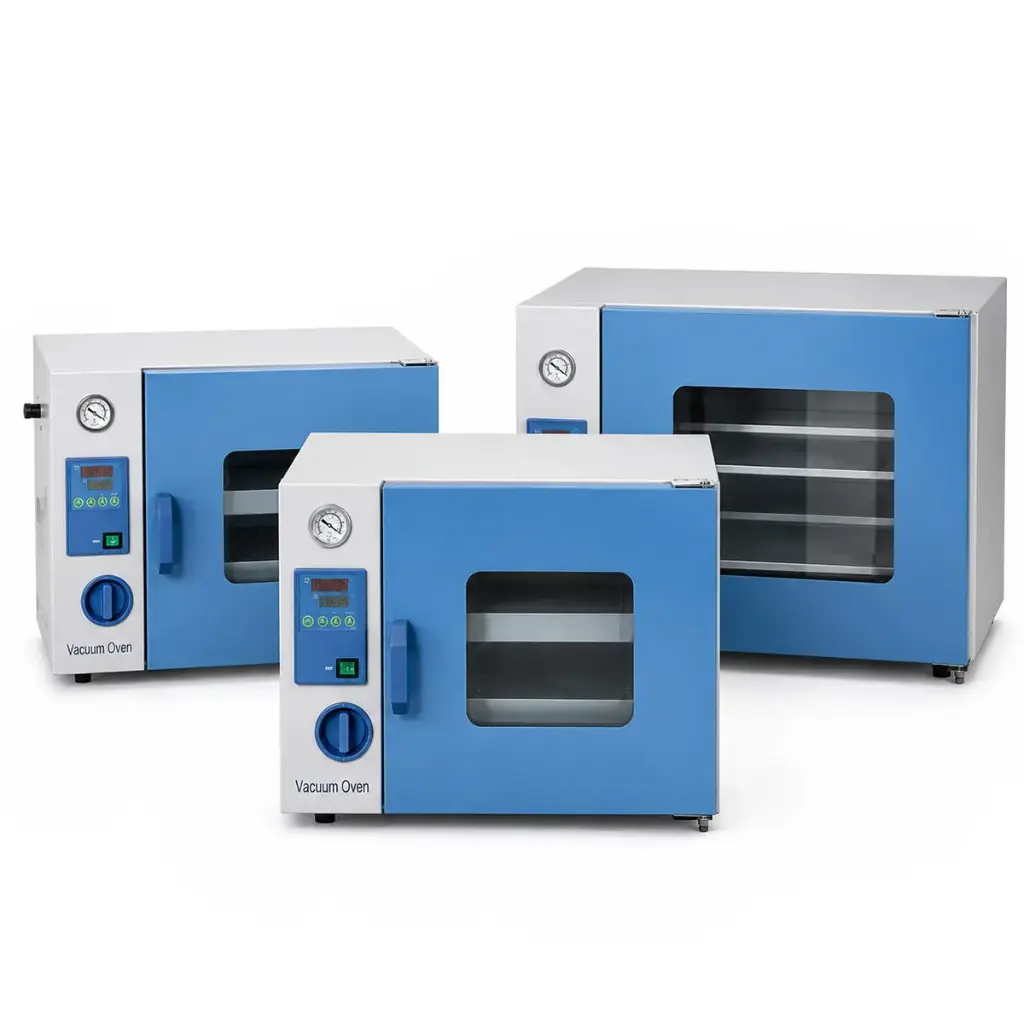
Laboratory Vacuum Drying Oven - LED PID Controller
https://www.s4r.fr/shop/laboratory-vacuum-drying-oven-led-pid-controller-309 https://www.s4r.fr/web/image/product.template/309/image_1920?unique=cff4d79The S4R Laboratory Vacuum Drying Oven is designed for controlled drying and thermal conditioning of laboratory materials under reduced pressure. Combining vacuum operation with programmable temperature control, the system provides a stable processing environment for materials requiring reduced-pressure drying or controlled thermal treatment.
The standard working chamber is manufactured from 304 stainless steel with a polished internal surface for routine laboratory cleaning and maintenance. An LED microprocessor PID controller provides temperature regulation, timing functionality and over-temperature protection, while the dual-layer tempered-glass door allows direct observation of the chamber during operation.
The S4R VDO series covers multiple chamber capacities and configurations for laboratory-scale processing. Optional KF25 vacuum connection, inert-gas inlet valve and door LED lighting allow the oven to be adapted to specific vacuum and controlled-atmosphere workflows.
No account required. Add the products you need, then send your request to our technical sales team.
Request Pricing AccessAlready have an approved account? Sign in
Laboratory Vacuum Drying Oven
The VDO Series combines PID-controlled heating with reduced-pressure operation for drying, conditioning and thermal processing of powders, electrodes, ceramics and laboratory components. Reduced pressure lowers the evaporation temperature of water and compatible volatile compounds, which can allow thermosensitive or easily oxidised materials to be dried below the temperature required under atmospheric-pressure conditions.
Twenty-one references cover seven chamber volumes from 10 L to 216 L. Each reference defines a fixed combination of volume, heating power, shelf count, chamber material and temperature range.
Key Features
Built for controlled drying under reduced pressure
Vacuum-assisted drying
The specified vacuum degree is 133 Pa. Reduced-pressure operation lowers the evaporation temperature of water and compatible volatile compounds, supporting drying at lower temperatures and reduced exposure to residual oxygen.
PID temperature control
LED microprocessor controller with timing function and over-temperature alarm. Display resolution 0.1 °C, temperature stability ±1 °C.
Stainless-steel chamber
Mirror-polished 304 stainless-steel chamber on standard and VDO-B references. A 316 stainless-steel chamber is used on the 30 L chemistry references.
Sealed observation door
Dual-layer tempered glass window with an adjustable door system and silicone gasket, allowing the sample to be observed without breaking vacuum.
Heat transfer under vacuum
Loading affects drying behaviour
Under reduced pressure, convective heat transfer is reduced and heat transfer increasingly depends on conduction through the supporting surfaces and thermal radiation.
In practice, flat-bottomed containers and thin sample layers reach the setpoint more readily than deep vessels or loosely stacked material. Shelf count is therefore a process parameter as much as a capacity figure: more shelves distribute the load across more heated surfaces, while fewer shelves leave greater vertical clearance for tall containers.
Series Architecture
Three configurations
The reference defines chamber material, temperature range, volume, heating power and shelf count.
Standard
VDO 304 SS
Temperature: RT +10 to 200 °C
Volumes: 10, 24, 50, 90, 125, 216 L
Use: general laboratory vacuum drying
Chemistry
VDO 316 SS
Temperature: RT +10 to 200 °C
Volume: 30 L
Use: chemistry-oriented applications
Low temperature
VDO-B Series
Temperature: RT +10 to 65 °C
Volumes: 30 and 50 L
Use: low-temperature drying
Standard References
304 stainless steel, up to 200 °C
References sharing the same chamber volume differ by heating power and shelf count.
| Reference | Volume | Power | Shelves | Interior W × D × H | Exterior W × D × H |
|---|---|---|---|---|---|
| VDO-6012 | 10 L | 400 W | 2 | 220 × 210 × 220 mm | 500 × 375 × 410 mm |
| VDO-6020 | 24 L | 400 W | 1 | 300 × 300 × 275 mm | 605 × 490 × 450 mm |
| VDO-6022 | 24 L | 700 W | 2 | 300 × 300 × 275 mm | 605 × 490 × 450 mm |
| VDO-6024 | 24 L | 700 W | 4 | 300 × 300 × 275 mm | 605 × 490 × 450 mm |
| VDO-6050 | 50 L | 1450 W | 2 | 415 × 370 × 345 mm | 730 × 560 × 550 mm |
| VDO-6053 | 50 L | 1450 W | 3 | 415 × 370 × 345 mm | 730 × 560 × 550 mm |
| VDO-6055 | 50 L | 1450 W | 5 | 415 × 370 × 345 mm | 730 × 560 × 550 mm |
| VDO-6056 | 50 L | 1450 W | 6 | 415 × 370 × 345 mm | 730 × 560 × 550 mm |
| VDO-6092 | 90 L | 870 W | 2 | 450 × 450 × 450 mm | 740 × 610 × 591 mm |
| VDO-6094 | 90 L | 1950 W | 4 | 450 × 450 × 450 mm | 740 × 610 × 591 mm |
| VDO-6096 | 90 L | 1950 W | 6 | 450 × 450 × 450 mm | 740 × 610 × 591 mm |
| VDO-6123 | 125 L | 1500 W | 3 * | 500 × 500 × 500 mm | 790 × 660 × 641 mm |
| VDO-6126 | 125 L | 2300 W | 6 | 500 × 500 × 500 mm | 790 × 660 × 641 mm |
| VDO-6213 | 216 L | 1550 W | 3 * | 600 × 600 × 600 mm | 890 × 760 × 741 mm |
| VDO-6216 | 216 L | 2850 W | 6 | 600 × 600 × 600 mm | 890 × 760 × 741 mm |
* VDO-6123 and VDO-6213 are supplied with three independently temperature-controlled shelves.
Chemistry References
316 stainless steel, 30 L, up to 200 °C
The chemistry configurations use a 316 stainless-steel working chamber for laboratory applications requiring this chamber material. They are the only 30 L references rated to 200 °C.
| Reference | Volume | Power | Shelves | Interior W × D × H | Exterior W × D × H |
|---|---|---|---|---|---|
| VDO-6030A | 30 L | 850 W | 1 | 320 × 320 × 300 mm | 630 × 510 × 490 mm |
| VDO-6032 | 30 L | 850 W | 2 | 320 × 320 × 300 mm | 630 × 510 × 490 mm |
| VDO-6034 | 30 L | 850 W | 4 | 320 × 320 × 300 mm | 630 × 510 × 490 mm |
Low-Temperature References
304 stainless steel, up to 65 °C
The VDO-B references use lower heating power and a reduced temperature ceiling for samples that must not be taken far above ambient temperature.
| Reference | Volume | Power | Shelves | Interior W × D × H | Exterior W × D × H |
|---|---|---|---|---|---|
| VDO-6030B | 30 L | 300 W | 1 | 320 × 320 × 300 mm | 610 × 510 × 490 mm |
| VDO-6050B | 50 L | 650 W | 2 | 415 × 370 × 345 mm | 730 × 560 × 550 mm |
| VDO-6055B | 50 L | 650 W | 5 | 415 × 370 × 345 mm | 730 × 560 × 550 mm |
Control and regulation
Stability, resolution and what they describe
Specified temperature stability is ±1 °C, with a display resolution of 0.1 °C. The controller incorporates timing functionality and an over-temperature alarm.
Stability describes temperature variation over time at the sensor position. It is not the same as spatial uniformity across the chamber, which is not specified for this series and which may be influenced by loading, shelf position and vacuum conditions. Where a documented temperature distribution is required, the temperature at the sample position should be verified with an independent probe.
Specifications
Common to all VDO references
| Electrical requirement | AC 220 V / 50 Hz |
|---|---|
| Controller | LED microprocessor PID controller with timing function and over-temperature alarm |
| Temperature range — standard and 316 SS | RT +10 to 200 °C |
| Temperature range — VDO-B | RT +10 to 65 °C |
| Display resolution | 0.1 °C |
| Temperature stability | ±1 °C |
| Vacuum degree | 133 Pa (approx. 1 Torr) |
| Ambient operating temperature | +5 to +40 °C |
| Chamber material | 304 stainless steel, mirror-polished; 316 stainless steel on the 30 L chemistry references |
| Observation window | Dual-layer tempered glass |
| Door sealing | Adjustable door system with silicone gasket |
System integration
Planning the vacuum installation
The oven is the vacuum vessel of the installation. The complete vacuum installation may require a suitable vacuum pump, vacuum hose, fittings and process-specific accessories according to the intended configuration.
Achievable chamber pressure depends on the pump selected, the conductance of the connection, chamber loading and the condition of the door seal. For processes generating compatible vapours, appropriate vacuum-system protection may be required according to the material and process conditions. An optional inert gas valve allows controlled gas introduction into the chamber before opening.
Typical Applications
Laboratory materials and research workflows
Battery and electrode materials
Removal of residual solvent and moisture from coated electrodes, active powders and cell components before assembly, where exposure to water is detrimental to electrochemical performance.
Powders and ceramic precursors
Drying of milled powders, ceramic precursors, porous supports and specimens where sintering or subsequent processing requires a defined moisture state.
Laboratory components and tooling
Drying of coin-cell parts, jars, fixtures and assemblies after cleaning, prior to use in a glovebox or to storage under controlled conditions.
Thermosensitive and oxidation-prone materials
Processing of compatible materials that may degrade, oxidise or decompose under conventional atmospheric drying conditions, using reduced-pressure operation to support drying at lower temperatures.
Options
Ordered separately, not fitted as standard
The following items are available on request and must be specified with the order.
KF25 vacuum port
Standardised flange connection for direct assembly with KF25 hoses, valves and centring rings.
Inert gas valve
Dedicated inlet for controlled gas introduction into the chamber according to the intended laboratory process.
Door LED lighting
LED lighting for improved observation of the sample through the chamber door during operation.
Reference selection. Chamber volume alone does not define the configuration. Select the reference according to volume, heating power, shelf count, chamber material and temperature range. Note that no 304 stainless-steel reference is available in 30 L at 200 °C: a 30 L chamber rated to 200 °C is supplied in 316 stainless steel, while the 30 L VDO-B in 304 stainless steel is limited to 65 °C.
Chemical and safety limitations. No explosion-proof or ATEX rating is specified for this series. The ovens are not intended for drying flammable solvents or for use in explosive atmospheres. Compatibility between the sample, its residues and the stainless-steel chamber, the silicone gasket and the vacuum system should be verified before processing.
Laboratory Vacuum Drying Oven
The VDO Series combines PID-controlled heating with reduced-pressure operation for drying, conditioning and thermal processing of powders, electrodes, ceramics and laboratory components. Reduced pressure lowers the evaporation temperature of water and compatible volatile compounds, which can allow thermosensitive or easily oxidised materials to be dried below the temperature required under atmospheric-pressure conditions.
Twenty-one references cover seven chamber volumes from 10 L to 216 L. Each reference defines a fixed combination of volume, heating power, shelf count, chamber material and temperature range.
Key Features
Built for controlled drying under reduced pressure
Vacuum-assisted drying
The specified vacuum degree is 133 Pa. Reduced-pressure operation lowers the evaporation temperature of water and compatible volatile compounds, supporting drying at lower temperatures and reduced exposure to residual oxygen.
PID temperature control
LED microprocessor controller with timing function and over-temperature alarm. Display resolution 0.1 °C, temperature stability ±1 °C.
Stainless-steel chamber
Mirror-polished 304 stainless-steel chamber on standard and VDO-B references. A 316 stainless-steel chamber is used on the 30 L chemistry references.
Sealed observation door
Dual-layer tempered glass window with an adjustable door system and silicone gasket, allowing the sample to be observed without breaking vacuum.
Heat transfer under vacuum
Loading affects drying behaviour
Under reduced pressure, convective heat transfer is reduced and heat transfer increasingly depends on conduction through the supporting surfaces and thermal radiation.
In practice, flat-bottomed containers and thin sample layers reach the setpoint more readily than deep vessels or loosely stacked material. Shelf count is therefore a process parameter as much as a capacity figure: more shelves distribute the load across more heated surfaces, while fewer shelves leave greater vertical clearance for tall containers.
Series Architecture
Three configurations
The reference defines chamber material, temperature range, volume, heating power and shelf count.
Standard
VDO 304 SS
Temperature: RT +10 to 200 °C
Volumes: 10, 24, 50, 90, 125, 216 L
Use: general laboratory vacuum drying
Chemistry
VDO 316 SS
Temperature: RT +10 to 200 °C
Volume: 30 L
Use: chemistry-oriented applications
Low temperature
VDO-B Series
Temperature: RT +10 to 65 °C
Volumes: 30 and 50 L
Use: low-temperature drying
Standard References
304 stainless steel, up to 200 °C
References sharing the same chamber volume differ by heating power and shelf count.
| Reference | Volume | Power | Shelves | Interior W × D × H | Exterior W × D × H |
|---|---|---|---|---|---|
| VDO-6012 | 10 L | 400 W | 2 | 220 × 210 × 220 mm | 500 × 375 × 410 mm |
| VDO-6020 | 24 L | 400 W | 1 | 300 × 300 × 275 mm | 605 × 490 × 450 mm |
| VDO-6022 | 24 L | 700 W | 2 | 300 × 300 × 275 mm | 605 × 490 × 450 mm |
| VDO-6024 | 24 L | 700 W | 4 | 300 × 300 × 275 mm | 605 × 490 × 450 mm |
| VDO-6050 | 50 L | 1450 W | 2 | 415 × 370 × 345 mm | 730 × 560 × 550 mm |
| VDO-6053 | 50 L | 1450 W | 3 | 415 × 370 × 345 mm | 730 × 560 × 550 mm |
| VDO-6055 | 50 L | 1450 W | 5 | 415 × 370 × 345 mm | 730 × 560 × 550 mm |
| VDO-6056 | 50 L | 1450 W | 6 | 415 × 370 × 345 mm | 730 × 560 × 550 mm |
| VDO-6092 | 90 L | 870 W | 2 | 450 × 450 × 450 mm | 740 × 610 × 591 mm |
| VDO-6094 | 90 L | 1950 W | 4 | 450 × 450 × 450 mm | 740 × 610 × 591 mm |
| VDO-6096 | 90 L | 1950 W | 6 | 450 × 450 × 450 mm | 740 × 610 × 591 mm |
| VDO-6123 | 125 L | 1500 W | 3 * | 500 × 500 × 500 mm | 790 × 660 × 641 mm |
| VDO-6126 | 125 L | 2300 W | 6 | 500 × 500 × 500 mm | 790 × 660 × 641 mm |
| VDO-6213 | 216 L | 1550 W | 3 * | 600 × 600 × 600 mm | 890 × 760 × 741 mm |
| VDO-6216 | 216 L | 2850 W | 6 | 600 × 600 × 600 mm | 890 × 760 × 741 mm |
* VDO-6123 and VDO-6213 are supplied with three independently temperature-controlled shelves.
Chemistry References
316 stainless steel, 30 L, up to 200 °C
The chemistry configurations use a 316 stainless-steel working chamber for laboratory applications requiring this chamber material. They are the only 30 L references rated to 200 °C.
| Reference | Volume | Power | Shelves | Interior W × D × H | Exterior W × D × H |
|---|---|---|---|---|---|
| VDO-6030A | 30 L | 850 W | 1 | 320 × 320 × 300 mm | 630 × 510 × 490 mm |
| VDO-6032 | 30 L | 850 W | 2 | 320 × 320 × 300 mm | 630 × 510 × 490 mm |
| VDO-6034 | 30 L | 850 W | 4 | 320 × 320 × 300 mm | 630 × 510 × 490 mm |
Low-Temperature References
304 stainless steel, up to 65 °C
The VDO-B references use lower heating power and a reduced temperature ceiling for samples that must not be taken far above ambient temperature.
| Reference | Volume | Power | Shelves | Interior W × D × H | Exterior W × D × H |
|---|---|---|---|---|---|
| VDO-6030B | 30 L | 300 W | 1 | 320 × 320 × 300 mm | 610 × 510 × 490 mm |
| VDO-6050B | 50 L | 650 W | 2 | 415 × 370 × 345 mm | 730 × 560 × 550 mm |
| VDO-6055B | 50 L | 650 W | 5 | 415 × 370 × 345 mm | 730 × 560 × 550 mm |
Control and regulation
Stability, resolution and what they describe
Specified temperature stability is ±1 °C, with a display resolution of 0.1 °C. The controller incorporates timing functionality and an over-temperature alarm.
Stability describes temperature variation over time at the sensor position. It is not the same as spatial uniformity across the chamber, which is not specified for this series and which may be influenced by loading, shelf position and vacuum conditions. Where a documented temperature distribution is required, the temperature at the sample position should be verified with an independent probe.
Specifications
Common to all VDO references
| Electrical requirement | AC 220 V / 50 Hz |
|---|---|
| Controller | LED microprocessor PID controller with timing function and over-temperature alarm |
| Temperature range — standard and 316 SS | RT +10 to 200 °C |
| Temperature range — VDO-B | RT +10 to 65 °C |
| Display resolution | 0.1 °C |
| Temperature stability | ±1 °C |
| Vacuum degree | 133 Pa (approx. 1 Torr) |
| Ambient operating temperature | +5 to +40 °C |
| Chamber material | 304 stainless steel, mirror-polished; 316 stainless steel on the 30 L chemistry references |
| Observation window | Dual-layer tempered glass |
| Door sealing | Adjustable door system with silicone gasket |
System integration
Planning the vacuum installation
The oven is the vacuum vessel of the installation. The complete vacuum installation may require a suitable vacuum pump, vacuum hose, fittings and process-specific accessories according to the intended configuration.
Achievable chamber pressure depends on the pump selected, the conductance of the connection, chamber loading and the condition of the door seal. For processes generating compatible vapours, appropriate vacuum-system protection may be required according to the material and process conditions. An optional inert gas valve allows controlled gas introduction into the chamber before opening.
Typical Applications
Laboratory materials and research workflows
Battery and electrode materials
Removal of residual solvent and moisture from coated electrodes, active powders and cell components before assembly, where exposure to water is detrimental to electrochemical performance.
Powders and ceramic precursors
Drying of milled powders, ceramic precursors, porous supports and specimens where sintering or subsequent processing requires a defined moisture state.
Laboratory components and tooling
Drying of coin-cell parts, jars, fixtures and assemblies after cleaning, prior to use in a glovebox or to storage under controlled conditions.
Thermosensitive and oxidation-prone materials
Processing of compatible materials that may degrade, oxidise or decompose under conventional atmospheric drying conditions, using reduced-pressure operation to support drying at lower temperatures.
Options
Ordered separately, not fitted as standard
The following items are available on request and must be specified with the order.
KF25 vacuum port
Standardised flange connection for direct assembly with KF25 hoses, valves and centring rings.
Inert gas valve
Dedicated inlet for controlled gas introduction into the chamber according to the intended laboratory process.
Door LED lighting
LED lighting for improved observation of the sample through the chamber door during operation.
Reference selection. Chamber volume alone does not define the configuration. Select the reference according to volume, heating power, shelf count, chamber material and temperature range. Note that no 304 stainless-steel reference is available in 30 L at 200 °C: a 30 L chamber rated to 200 °C is supplied in 316 stainless steel, while the 30 L VDO-B in 304 stainless steel is limited to 65 °C.
Chemical and safety limitations. No explosion-proof or ATEX rating is specified for this series. The ovens are not intended for drying flammable solvents or for use in explosive atmospheres. Compatibility between the sample, its residues and the stainless-steel chamber, the silicone gasket and the vacuum system should be verified before processing.
Our latest content
Check out what's new in our company !