- All Products
- All Products
- Digital Manual Hydraulic Laboratory Press
Digital Manual Hydraulic Laboratory Press
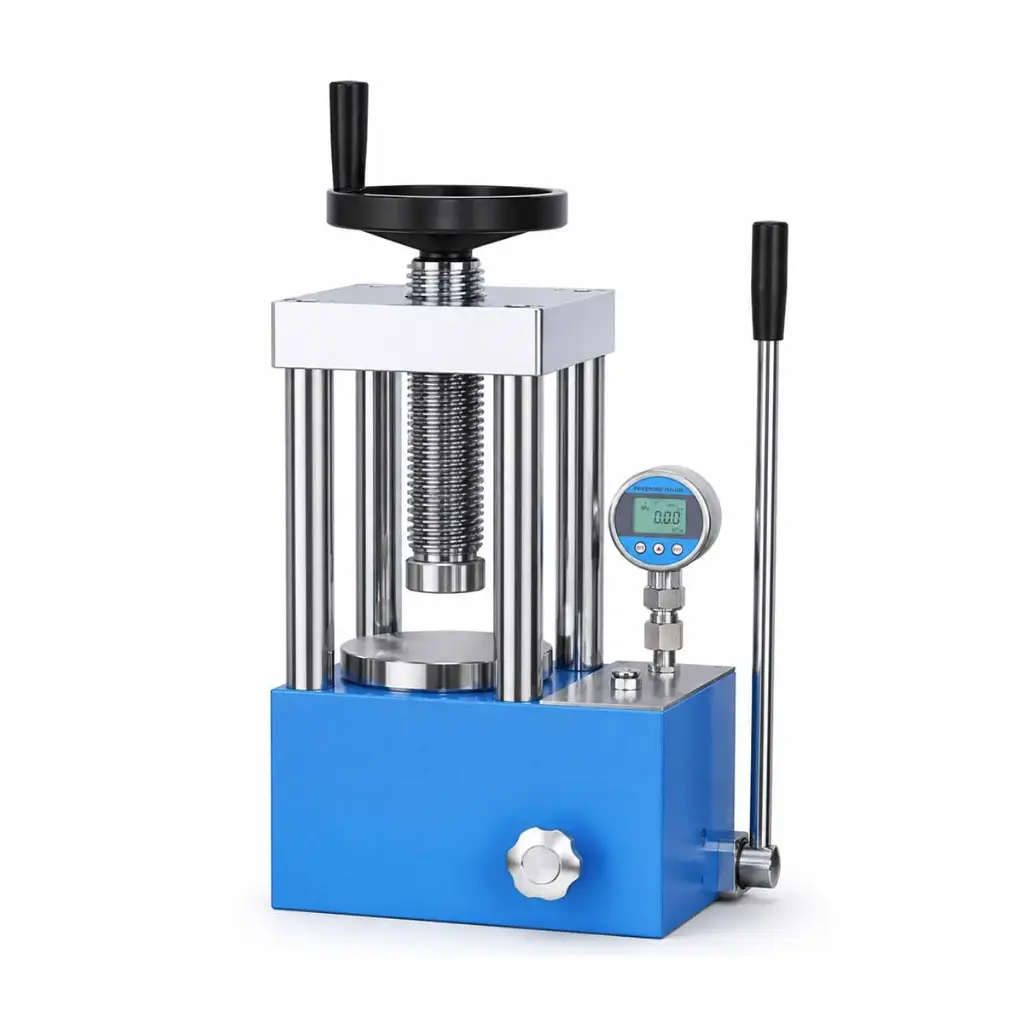
https://www.s4r.fr/shop/digital-manual-hydraulic-laboratory-press-315 https://www.s4r.fr/web/image/product.template/315/image_1920?unique=1c48c5eThe S4R Digital Manual Hydraulic Laboratory Press is a compact benchtop press designed for controlled compaction of powders, pellets, electrodes, solid electrolytes, ceramic materials, and laboratory samples requiring reproducible mechanical loading.
A manually operated hydraulic system provides high pressing force without the complexity of an electrically driven press, while the integrated digital load display provides direct real-time monitoring of the applied load with a display resolution of 0.01 ton.
Seven load capacities from 3 to 40 tons allow the press to be selected according to sample diameter, die geometry, target compaction pressure, and available laboratory workspace. The 15-ton configuration uses the enlarged 140 × 160 mm working area selected by S4R for improved versatility.
The range is particularly suitable for solid-state battery research, powder compaction, pellet preparation, ceramic processing, electrode preparation, spectroscopy samples, and general materials research.
Already have an approved account? Sign in
3–40 Ton Laboratory Press
The S4R Digital Manual Hydraulic Laboratory Press is designed for controlled compaction of powders, pellets, electrodes, solid electrolytes, ceramic materials, and other laboratory samples requiring high mechanical loads in a compact benchtop format.
Manual hydraulic actuation provides progressive force generation while the integrated digital display gives a direct indication of the applied load. Seven capacities from 3 to 40 tons allow the press to be matched to the required die size, sample area, and target compaction pressure.
Controlled laboratory pressing from 3 to 40 tons
A manual platform combining high mechanical load, compact construction, and direct digital load monitoring.
Direct force indication without analogue gauge interpretation
The integrated digital display indicates the applied load directly in tons-force. This simplifies monitoring during sample preparation and removes the need to estimate the applied force from the position of an analogue pressure-gauge needle.
Across the range, the displayed load resolution is 0.01 ton on every configuration, so a defined pressing condition can be reproduced from one experiment to the next.
Seven capacities, one operating principle
Frame dimensions, cylinder diameter and working space vary with the selected capacity. Display resolution is 0.01 ton on all configurations.
| Capacity | Maximum force | Cylinder Ø | Stroke | Working space W × H | External dimensions W × D × H | Net mass |
|---|---|---|---|---|---|---|
| 3 t | 29.4 kN | Ø35 mm | 30 mm | 96 × 130 mm | 225 × 155 × 380 mm | 28 kg |
| 5 t | 49.0 kN | Ø50 mm | 30 mm | 90 × 125 mm | 210 × 150 × 360 mm | 20 kg |
| 12 t | 117.7 kN | Ø70 mm | 30 mm | 96 × 130 mm | 225 × 155 × 380 mm | 28 kg |
| 15 t | 147.1 kN | Ø80 mm | 30 mm | 140 × 160 mm | 270 × 200 × 440 mm | 55 kg |
| 24 t | 235.4 kN | Ø95 mm | 30 mm | 80 × 150 mm | 250 × 175 × 415 mm | 42 kg |
| 30 t | 294.2 kN | Ø110 mm | 30 mm | 92 × 160 mm | 270 × 200 × 440 mm | 56 kg |
| 40 t | 392.3 kN | Ø130 mm | 40 mm | 106 × 180 mm | 295 × 215 × 500 mm | 75 kg |
Select capacity from the compressed area, not the sample diameter alone
The pressure generated inside a pellet depends on the applied load and on the effective compressed area, so a small-diameter die reaches a high nominal pressure with a comparatively modest load.
| Pellet diameter | 100 MPa | 200 MPa | 300 MPa | 400 MPa |
|---|---|---|---|---|
| Ø10 mm | 0.80 t | 1.60 t | 2.40 t | 3.20 t |
| Ø13 mm | 1.35 t | 2.71 t | 4.06 t | 5.41 t |
| Ø15 mm | 1.80 t | 3.60 t | 5.41 t | 7.21 t |
| Ø20 mm | 3.20 t | 6.41 t | 9.61 t | 12.81 t |
| Ø25 mm | 5.01 t | 10.01 t | 15.02 t | 20.02 t |
| Ø30 mm | 7.21 t | 14.42 t | 21.62 t | 28.83 t |
Manual loading with progressive hydraulic force
The press combines mechanical height adjustment with a manually operated hydraulic cylinder. The sample or die assembly is positioned centrally on the lower working platform before the upper pressing element is brought to the required starting position.
Sample preparation across battery and materials research
Suitable for controlled mechanical compaction where high force and direct load monitoring are required.
Common to all configurations
| Parameter | Specification |
|---|---|
| Product type | Digital manual hydraulic laboratory press |
| Available capacities | 3, 5, 12, 15, 24, 30 and 40 tons |
| Actuation | Manual hydraulic |
| Load monitoring | Integrated digital load display, indicated in tons-force |
| Display resolution | 0.01 ton on all configurations |
| Maximum equivalent force | 29.4 to 392.3 kN according to the selected capacity |
| Hydraulic cylinder diameter | Ø35 to Ø130 mm according to the selected capacity |
| Hydraulic stroke | 30 mm for the 3 to 30 ton configurations; 40 mm for the 40 ton configuration |
| Working space | 80 × 150 mm to 140 × 160 mm according to the selected configuration |
| External dimensions | 210 × 150 × 360 mm to 295 × 215 × 500 mm according to the selected configuration |
| Net mass | 20 to 75 kg according to the selected configuration |
| Installation | Laboratory benchtop |
| Compatible tooling | Appropriately rated pellet dies, powder-compaction dies and compression fixtures matching the working-space dimensions |
Supplied ready for benchtop installation
Centred loading and correctly rated tooling
The sample or die assembly must be positioned centrally between the loading surfaces. Off-axis loading generates bending forces and can damage the press, the tooling or the sample assembly.
Load should be applied and released progressively. Appropriate personal protective equipment and, where required by the laboratory risk assessment, suitable guarding should be used when compacting brittle materials or operating high-load dies.
3–40 Ton Laboratory Press
The S4R Digital Manual Hydraulic Laboratory Press is designed for controlled compaction of powders, pellets, electrodes, solid electrolytes, ceramic materials, and other laboratory samples requiring high mechanical loads in a compact benchtop format.
Manual hydraulic actuation provides progressive force generation while the integrated digital display gives a direct indication of the applied load. Seven capacities from 3 to 40 tons allow the press to be matched to the required die size, sample area, and target compaction pressure.
Controlled laboratory pressing from 3 to 40 tons
A manual platform combining high mechanical load, compact construction, and direct digital load monitoring.
Direct force indication without analogue gauge interpretation
The integrated digital display indicates the applied load directly in tons-force. This simplifies monitoring during sample preparation and removes the need to estimate the applied force from the position of an analogue pressure-gauge needle.
Across the range, the displayed load resolution is 0.01 ton on every configuration, so a defined pressing condition can be reproduced from one experiment to the next.
Seven capacities, one operating principle
Frame dimensions, cylinder diameter and working space vary with the selected capacity. Display resolution is 0.01 ton on all configurations.
| Capacity | Maximum force | Cylinder Ø | Stroke | Working space W × H | External dimensions W × D × H | Net mass |
|---|---|---|---|---|---|---|
| 3 t | 29.4 kN | Ø35 mm | 30 mm | 96 × 130 mm | 225 × 155 × 380 mm | 28 kg |
| 5 t | 49.0 kN | Ø50 mm | 30 mm | 90 × 125 mm | 210 × 150 × 360 mm | 20 kg |
| 12 t | 117.7 kN | Ø70 mm | 30 mm | 96 × 130 mm | 225 × 155 × 380 mm | 28 kg |
| 15 t | 147.1 kN | Ø80 mm | 30 mm | 140 × 160 mm | 270 × 200 × 440 mm | 55 kg |
| 24 t | 235.4 kN | Ø95 mm | 30 mm | 80 × 150 mm | 250 × 175 × 415 mm | 42 kg |
| 30 t | 294.2 kN | Ø110 mm | 30 mm | 92 × 160 mm | 270 × 200 × 440 mm | 56 kg |
| 40 t | 392.3 kN | Ø130 mm | 40 mm | 106 × 180 mm | 295 × 215 × 500 mm | 75 kg |
Select capacity from the compressed area, not the sample diameter alone
The pressure generated inside a pellet depends on the applied load and on the effective compressed area, so a small-diameter die reaches a high nominal pressure with a comparatively modest load.
| Pellet diameter | 100 MPa | 200 MPa | 300 MPa | 400 MPa |
|---|---|---|---|---|
| Ø10 mm | 0.80 t | 1.60 t | 2.40 t | 3.20 t |
| Ø13 mm | 1.35 t | 2.71 t | 4.06 t | 5.41 t |
| Ø15 mm | 1.80 t | 3.60 t | 5.41 t | 7.21 t |
| Ø20 mm | 3.20 t | 6.41 t | 9.61 t | 12.81 t |
| Ø25 mm | 5.01 t | 10.01 t | 15.02 t | 20.02 t |
| Ø30 mm | 7.21 t | 14.42 t | 21.62 t | 28.83 t |
Manual loading with progressive hydraulic force
The press combines mechanical height adjustment with a manually operated hydraulic cylinder. The sample or die assembly is positioned centrally on the lower working platform before the upper pressing element is brought to the required starting position.
Sample preparation across battery and materials research
Suitable for controlled mechanical compaction where high force and direct load monitoring are required.
Common to all configurations
| Parameter | Specification |
|---|---|
| Product type | Digital manual hydraulic laboratory press |
| Available capacities | 3, 5, 12, 15, 24, 30 and 40 tons |
| Actuation | Manual hydraulic |
| Load monitoring | Integrated digital load display, indicated in tons-force |
| Display resolution | 0.01 ton on all configurations |
| Maximum equivalent force | 29.4 to 392.3 kN according to the selected capacity |
| Hydraulic cylinder diameter | Ø35 to Ø130 mm according to the selected capacity |
| Hydraulic stroke | 30 mm for the 3 to 30 ton configurations; 40 mm for the 40 ton configuration |
| Working space | 80 × 150 mm to 140 × 160 mm according to the selected configuration |
| External dimensions | 210 × 150 × 360 mm to 295 × 215 × 500 mm according to the selected configuration |
| Net mass | 20 to 75 kg according to the selected configuration |
| Installation | Laboratory benchtop |
| Compatible tooling | Appropriately rated pellet dies, powder-compaction dies and compression fixtures matching the working-space dimensions |
Supplied ready for benchtop installation
Centred loading and correctly rated tooling
The sample or die assembly must be positioned centrally between the loading surfaces. Off-axis loading generates bending forces and can damage the press, the tooling or the sample assembly.
Load should be applied and released progressively. Appropriate personal protective equipment and, where required by the laboratory risk assessment, suitable guarding should be used when compacting brittle materials or operating high-load dies.
Our latest content
Check out what's new in our company !