Skip to Content

Acrylic Vacuum Chamber

https://www.s4r.fr/web/image/product.template/319/image_1920?unique=3fd657d

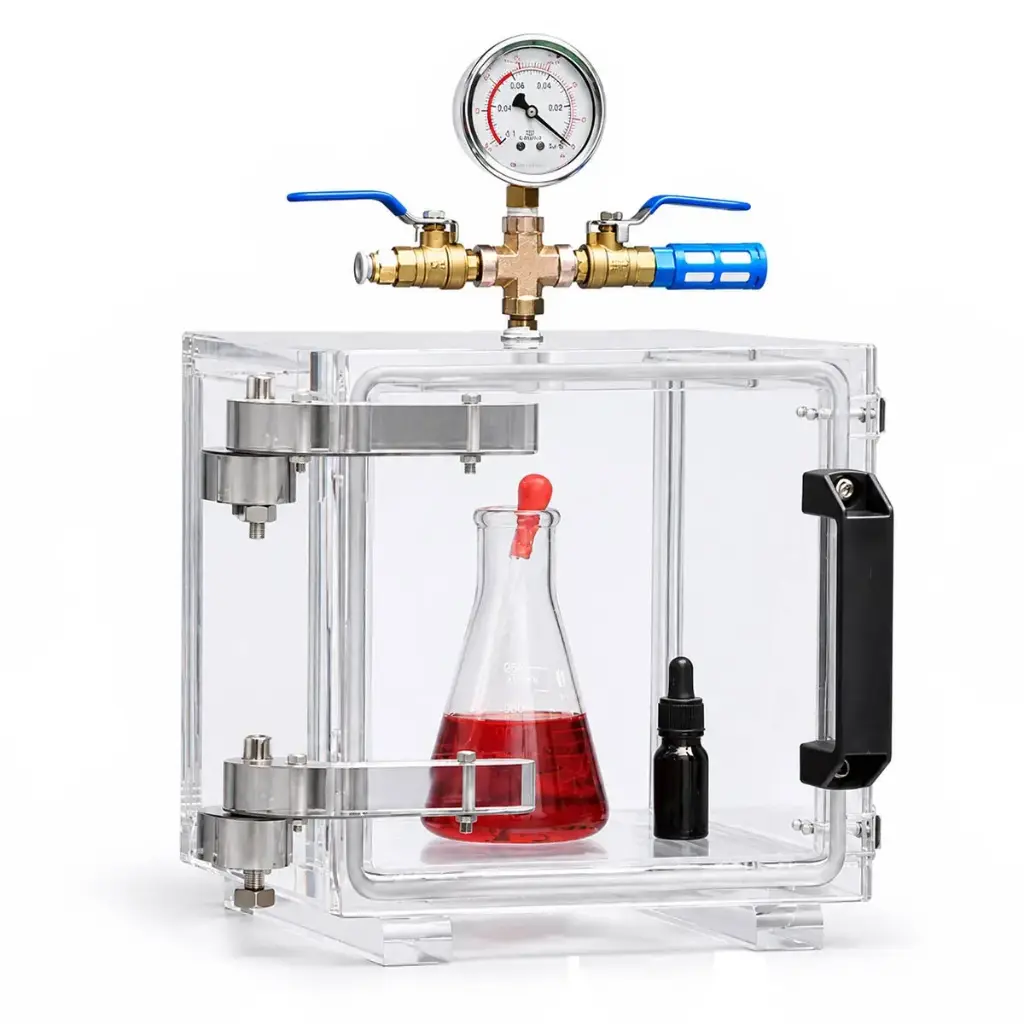
The S4R Benchtop Acrylic Vacuum Chamber provides a compact and fully transparent environment for laboratory operations requiring controlled evacuation, vacuum holding and direct observation of the process.

Manufactured from high-transparency acrylic, the enclosure incorporates external structural reinforcement to provide the rigidity required for routine operation under negative pressure. The transparent construction keeps samples, vessels and experimental assemblies visible throughout evacuation, processing and pressure recovery.

The chamber is connected to an external vacuum pump through a dedicated manual valve. Once the required pressure has been reached, the chamber can be isolated for vacuum holding. A second valve provides controlled venting and can also be used to introduce a compatible inert gas from an external supply when the experimental procedure requires vacuum/backfill cycles.

Two standard configurations are available. The 300 × 300 × 300 mm model provides a compact format for routine benchtop work, while the 400 × 400 × 400 mm version offers additional space for larger vessels, fixtures and experimental assemblies.

Typical applications include vacuum degassing, vacuum-assisted conditioning and drying, preparation of battery and electrochemical materials, materials research, electronic component testing and other laboratory procedures requiring an observable reduced-pressure environment.

The chamber is designed as a vacuum processing system rather than a gas-purification glove box. It does not incorporate continuous gas recirculation or ppm-level oxygen and moisture purification.

0.00 € 0.0 EUR 0.00 €

Pricing available to approved customers

Sign in to view your pricing, or request access to an S4R professional account.

  • Chamber Size

This combination does not exist.

Request Pricing Access
Laboratory Vacuum Processing

Benchtop Acrylic Vacuum Chamber

Fully transparent chamber for controlled evacuation, vacuum holding and direct observation

The S4R Benchtop Acrylic Vacuum Chamber provides a compact and fully visible environment for laboratory operations requiring controlled evacuation. Its transparent construction keeps samples, vessels and experimental assemblies observable throughout evacuation, processing and pressure recovery.

External reinforcing ribs increase the rigidity of the acrylic enclosure during routine operation under negative pressure. A chamber-mounted vacuum gauge and two manual valve connections provide straightforward control of evacuation, chamber isolation, controlled venting and, where required, inert-gas backfilling from an external supply.

Standard models
300 & 400 mm
Gauge vacuum
Down to −0.1 MPa
Leakage rate
≤ 0.001 vol%/h
Enclosure
High-transparency acrylic
Product Highlights

Designed for visible, controlled vacuum processing

A compact laboratory platform combining transparent construction, reinforced acrylic and straightforward manual vacuum control.

01

Full visual access

The transparent enclosure provides direct observation of the internal workspace throughout evacuation, vacuum holding and venting.

02

Reinforced acrylic enclosure

External structural reinforcement increases chamber rigidity and helps limit deformation during negative-pressure operation.

03

Manual vacuum control

A local gauge and dedicated valve connections allow evacuation, isolation, venting and gas backfilling to be controlled directly.

04

Two laboratory sizes

Choose the compact 300 mm configuration for routine work or the 400 mm version when additional internal working space is required.

Operating Principle

Pump down, hold, backfill and vent

The chamber operates through controlled removal of the internal atmosphere using an external vacuum pump. The sequence can be adapted to vacuum-holding or vacuum/backfill procedures according to the experimental workflow.

01
Evacuation

Pump down the chamber

Load the samples or experimental assembly, close the chamber and operate the external vacuum pump until the required pressure is reached.

02
Holding

Isolate the working volume

Close the vacuum valve once the required pressure has been reached. The chamber can then remain isolated for the required process or holding period.

03
Backfill

Introduce inert gas when required

For vacuum/backfill procedures, introduce a compatible inert gas from an external supply through the dedicated valve connection.

04
Recovery

Vent before opening

At the end of the process, return the chamber progressively to atmospheric pressure through the vent valve before opening the enclosure.

Construction & Vacuum Interface

Transparent enclosure with integrated vacuum monitoring

High-transparency acrylic provides direct visibility of the workspace, while external reinforcing sections support the enclosure during routine negative-pressure operation.

Enclosure

High-transparency acrylic

Transparent construction provides clear observation of samples, containers and experimental assemblies.

Structure

External reinforcement

Structural acrylic sections reinforce the chamber for operation under negative pressure.

Monitoring

Local vacuum gauge

A chamber-mounted gauge provides direct pressure indication during evacuation and vacuum holding.

Control

Manual valve interface

Separate connections support evacuation and isolation as well as controlled venting or compatible gas introduction.

Model Selection

Two chamber sizes for laboratory-scale workflows

The AVC-300 provides a compact footprint for routine laboratory procedures, while the AVC-400 offers additional working space for larger vessels, fixtures and experimental assemblies.

Parameter AVC-300 AVC-400
S4R reference S4R-AVC-300 S4R-AVC-400
Nominal chamber size 300 × 300 × 300 mm 400 × 400 × 400 mm
Chamber material High-transparency acrylic High-transparency acrylic
Structural acrylic thickness 20–50 mm depending on structural section 20–50 mm depending on structural section
Gauge vacuum Down to −0.1 MPa Down to −0.1 MPa
Leakage rate ≤ 0.001 vol%/h ≤ 0.001 vol%/h
Vacuum pump Optional Optional
Nominal chamber dimensions The stated dimensions identify the standard chamber configurations. Structural sections and external fittings form part of the complete chamber assembly.
Product Data

Technical specifications

Common technical characteristics of the AVC-300 and AVC-400 configurations.

Parameter Specification
Product type Benchtop acrylic vacuum chamber for laboratory use
Available configurations AVC-300 and AVC-400
Chamber material High-transparency acrylic
Construction Transparent acrylic enclosure with external structural reinforcement
Structural acrylic thickness 20–50 mm depending on structural section
Gauge vacuum Down to −0.1 MPa
Leakage rate ≤ 0.001 vol%/h
Pressure indication Chamber-mounted vacuum gauge
Evacuation source External vacuum pump
Vacuum isolation Manual valve
Venting / gas introduction Manual valve connection
Inert-gas backfill Supported using an external compatible gas supply
Operating pressure mode Negative pressure
Vacuum pump Available as an option
Automatic pressure control Available as an option
Temperature-controlled configuration High- or low-temperature configurations available for specialised applications
Custom configuration Application-specific chamber configurations available
Typical Applications

Vacuum processing for research and sample preparation

Designed for laboratory workflows requiring a visible and controlled reduced-pressure environment for conditioning, processing or testing.

Battery and materials research

Vacuum conditioning and preparation of compatible electrodes, powders, components and materials used in laboratory research.

Vacuum degassing

Removal of trapped air from compatible liquids, slurries, resins and other formulations before subsequent processing.

Vacuum-assisted conditioning and drying

Reduced-pressure treatment of compatible materials where vacuum-assisted removal of moisture or volatile species is required.

Component and materials testing

Experimental procedures involving electronic components, materials or assemblies that require controlled operation under negative pressure.

Standard Configuration

Core chamber configuration

The standard chamber integrates the essential components required for manual laboratory vacuum operation.

Chamber

Acrylic enclosure

Transparent reinforced chamber in the selected AVC-300 or AVC-400 configuration.

Monitoring

Vacuum gauge

Local chamber-mounted gauge for monitoring pressure during routine operation.

Vacuum interface

Manual valve assembly

Valve connections for evacuation and chamber isolation, together with controlled venting or compatible gas introduction.

Optional equipment Vacuum pumps and automatic pressure-control systems are available as optional configurations according to the required operating workflow.
Acrylic compatibility Review the chemical compatibility of acrylic before introducing solvents, vapours or reactive materials into the chamber. Alternative chamber configurations can be considered for applications requiring different material compatibility.
Vacuum performance The specified −0.1 MPa value is a gauge vacuum. Actual system performance also depends on the connected vacuum pump, external vacuum circuit, chamber closure and sealing condition.
Vacuum chamber — not a purification glove box The chamber provides a reduced-pressure environment and supports vacuum/backfill procedures with an external compatible gas supply. It does not incorporate continuous gas recirculation, oxygen removal or moisture purification and therefore does not provide ppm-level H₂O or O₂ control.

Our latest content

Check out what's new in our company !

Your Dynamic Snippet will be displayed here... This message is displayed because you did not provide both a filter and a template to use.