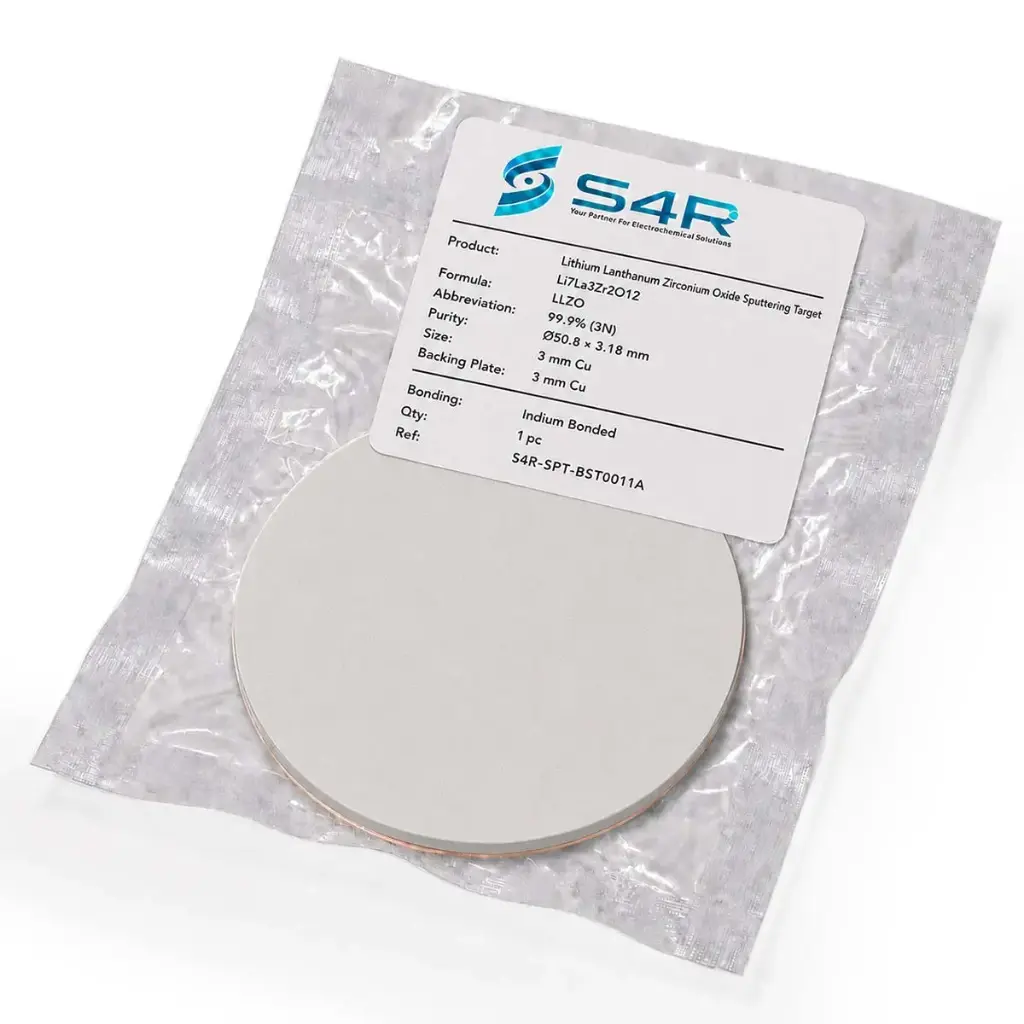
Lithium Lanthanum Zirconium Oxide Sputtering Target (Li₇La₃Zr₂O₁₂, LLZO)
The S4R Lithium Lanthanum Zirconium Oxide Sputtering Target is manufactured from high-purity Li₇La₃Zr₂O₁₂ ceramic for physical vapor deposition and magnetron sputtering applications.
Lithium lanthanum zirconium oxide, commonly designated LLZO, is a lithium-containing garnet-type oxide investigated as a solid-electrolyte material for lithium batteries. It is relevant to solid-state battery research, lithium-ion-conducting ceramic films, electrolyte–electrode interface studies and protective or functional oxide coatings.
The product described here corresponds to undoped Li₇La₃Zr₂O₁₂, as no dopant is specified on the material label. It must therefore be distinguished from doped LLZO compositions containing elements such as tantalum, aluminum, gallium or niobium.
The standard S4R configuration is supplied as a 2-inch ceramic target indium-bonded to a 3 mm thick copper backing plate, with a purity of 99.99% (4N):
- Target diameter: Ø50.8 mm (2 in.)
- LLZO target thickness: 3.18 mm (0.125 in.)
- Copper backing plate thickness: 3 mm
- Total nominal assembly thickness: approximately 6.18 mm, excluding the bonding layer
- Standard bonding method: indium bonding
- Purity: 99.99% (4N)
- Nominal composition: Li₇La₃Zr₂O₁₂
- Doping: none specified
Alternative target dimensions, backing-plate materials, backing-plate geometries, bonding methods and unbonded configurations may be available upon request. Final compatibility must be confirmed according to the customer’s sputtering cathode and mounting system.
The crystalline phase is not specified by the available material information. The product page should therefore not claim a guaranteed cubic or tetragonal LLZO phase unless this is confirmed by additional supplier documentation or phase-analysis data.
Already have an approved account? Sign in
Sputtering and Compatibility
LLZO is an electrically insulating multicomponent ceramic oxide. RF magnetron sputtering is therefore the recommended standard starting method for this target configuration.
The copper backing plate provides mechanical support and promotes heat transfer between the ceramic target and the cooled sputtering cathode. The indium bonding layer improves thermal contact while accommodating part of the thermal-expansion difference between the ceramic target and the metallic backing plate.
Actual deposition conditions depend on:
- sputtering-source design;
- RF generator and matching network;
- target density, porosity and microstructure;
- lithium content and chemical homogeneity;
- oxygen stoichiometry;
- target phase and any dopant content;
- bonding quality and cathode cooling;
- sputtering-gas composition and pressure;
- substrate material and temperature;
- desired film composition and structure;
- post-deposition thermal treatment.
S4R does not specify universal RF power, gas pressure, substrate temperature or annealing conditions. These parameters must be developed according to the customer’s equipment and required film properties.
The deposited film should not automatically be assumed to reproduce the bulk target composition or crystalline structure exactly. Lithium loss, preferential sputtering, oxygen non-stoichiometry and thermal treatment may affect the resulting film. Its elemental composition, lithium content and phase should therefore be verified experimentally.
Our latest content
Check out what's new in our company !