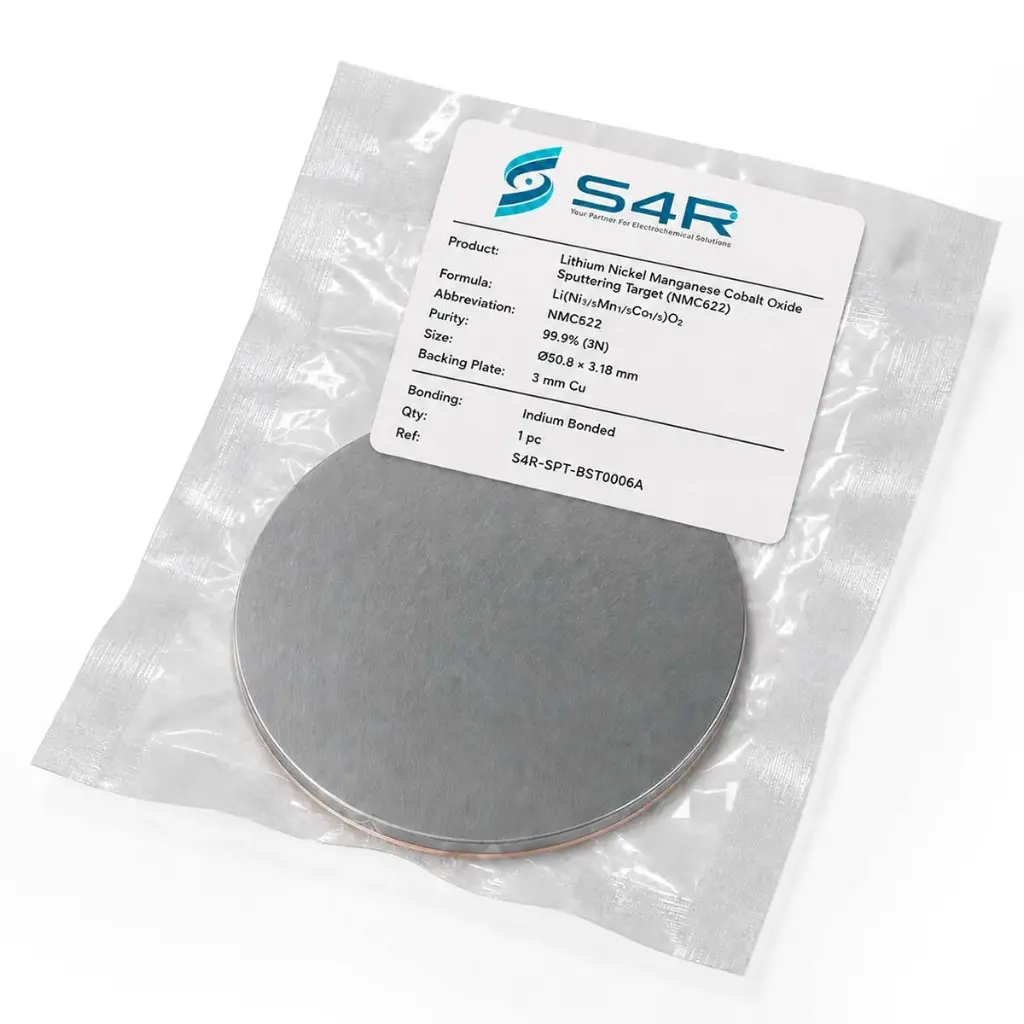
Lithium Nickel Manganese Cobalt Oxide Sputtering Target (NMC622)
The S4R Lithium Nickel Manganese Cobalt Oxide Sputtering Target is manufactured from a multicomponent ceramic material with a nominal nickel, manganese and cobalt molar ratio of 6:2:2 for physical vapor deposition and magnetron sputtering applications.
The normalized composition is:
LiNi₀.₆Mn₀.₂Co₀.₂O₂
This composition is commonly designated NMC622, or NCM622 when cobalt is written before manganese. It belongs to the family of nickel-rich layered lithium transition-metal oxides used as positive-electrode materials in lithium-ion battery research. The designation “622” refers specifically to the nominal transition-metal ratio Ni:Mn:Co = 6:2:2.
In thin-film form, NMC622 is relevant to lithium-ion battery research, microbattery development, all-solid-state battery studies, cathode–electrolyte interface investigations and electrochemical thin-film characterization.
The standard S4R configuration is supplied as a 2-inch ceramic target indium-bonded to a 3 mm thick copper backing plate:
- Target diameter: Ø50.8 mm (2 in.)
- NMC622 target thickness: 3.18 mm (0.125 in.)
- Copper backing plate thickness: 3 mm
- Total nominal assembly thickness: approximately 6.18 mm, excluding the bonding layer
- Standard bonding method: indium bonding
- Ni:Mn:Co molar ratio: 6:2:2
- Purity: to be confirmed according to the product specification and batch certificate
Alternative dimensions, backing-plate configurations, bonding methods and unbonded targets may be available upon request. Final compatibility must be confirmed according to the customer’s sputtering cathode and mounting system.
The standard product corresponds to the nominal NMC622 composition. Lithium-enriched, lithium-deficient, doped, coated or otherwise modified compositions must be identified separately and should not be presented as equivalent to standard NMC622.
No account required. Add the products you need, then send your request to our technical sales team.
Request Pricing AccessAlready have an approved account? Sign in
Sputtering and Compatibility
NMC622 is a multicomponent ceramic oxide. RF magnetron sputtering is therefore the prudent standard recommendation for this bonded target configuration.
The copper backing plate provides mechanical support and promotes heat transfer between the ceramic target and the cooled sputtering cathode. The indium bonding layer improves thermal contact while accommodating part of the thermal-expansion difference between the ceramic target and the metallic support.
Actual deposition conditions depend on:
- sputtering-source design;
- RF generator and matching network;
- target density, porosity and microstructure;
- chemical homogeneity and lithium content;
- bonding quality and cathode cooling;
- sputtering-gas composition and pressure;
- substrate material and temperature;
- required film stoichiometry and crystallinity;
- post-deposition thermal treatment.
S4R should not specify a universal RF power, gas pressure, substrate temperature or annealing condition. These parameters must be developed according to the customer’s equipment and required film properties.
The deposited film should not automatically be assumed to reproduce the bulk target composition exactly. Lithium-containing multicomponent oxides may undergo lithium loss, preferential sputtering or other composition changes during deposition and subsequent thermal treatment. The final film composition and crystalline phase should therefore be verified experimentally.
Our latest content
Check out what's new in our company !