- All Products
- All Products
- Digital Pirani Vacuum Gauge
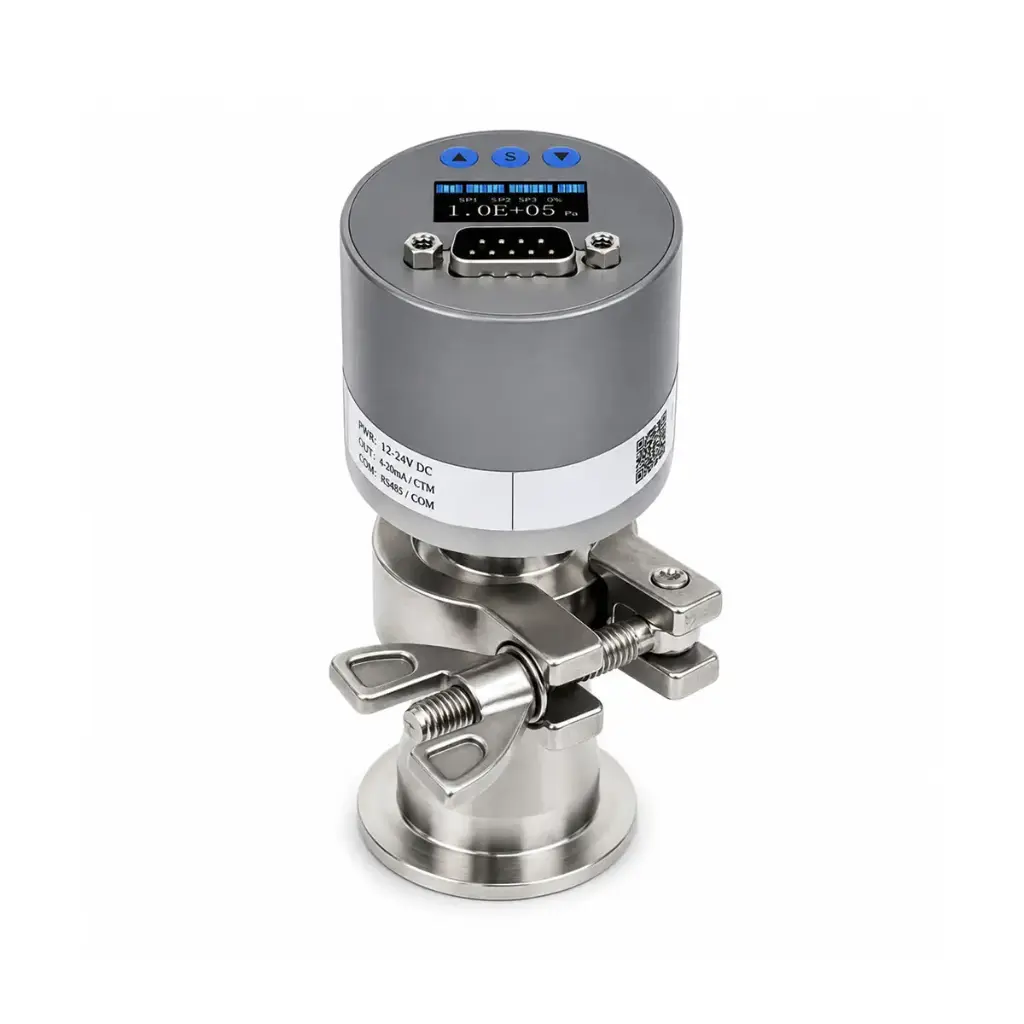
Digital Pirani Vacuum Gauge
https://www.s4r.fr/shop/digital-pirani-vacuum-gauge-318 https://www.s4r.fr/web/image/product.template/318/image_1920?unique=ae06355Already have an approved account? Sign in
0.05 Pa–120 kPa Wide-Range Vacuum Measurement
The S4R PVG-120 Digital Pirani Vacuum Gauge provides continuous absolute-pressure measurement from atmospheric pressure down to 0.05 Pa for laboratory and materials-research vacuum systems.
A composite sensing architecture, an integrated display showing pressure and sensor temperature, and both digital and analog outputs combine local indication with direct integration into laboratory equipment and process-control systems.
Wide-range monitoring in one compact instrument
Local pressure indication and electronic system integration from atmospheric pressure through the primary and medium vacuum range.
Composite sensing from atmosphere to medium vacuum
Pirani measurement is based on the relationship between gas pressure and thermal conductivity. As pressure falls, heat transfer from the heated sensing element to the surrounding gas decreases, producing a pressure-dependent electrical response. This relationship flattens out above a few thousand pascal, which is why a Pirani element alone cannot cover the region close to atmospheric pressure.
The PVG-120 combines the Pirani element with an additional pressure-sensing stage, so a single instrument delivers a continuous reading from 120 kPa down to 0.05 Pa without the operator switching between two gauges.
Specified accuracy by pressure range
Measurement uncertainty is strongly pressure-dependent and should be considered when selecting the gauge for quantitative process control.
| Pressure range | Specified error | Measurement region |
|---|---|---|
| 5 × 10⁻² to 1 × 10⁻¹ Pa | ±50 % of reading | Lower measurement limit |
| 1 × 10⁻¹ to 1.5 × 10⁴ Pa | ±15 % of reading | Primary and medium vacuum |
| 1.5 × 10⁴ to 1.2 × 10⁵ Pa | ±0.5 % of reading | Near-atmospheric region |
Local display with digital and analog outputs
The gauge works as a standalone local indicator and simultaneously provides electronic signals to compatible monitoring and control systems, so no separate display controller is required at the vacuum line.
Designed for primary and medium-vacuum monitoring
The measurement range matches the working region of mechanical vacuum pumps, vacuum chambers and process equipment operating from atmospheric pressure through primary and medium vacuum. A single gauge therefore covers the whole pump-down curve of a rotary-vane or dry-scroll system.
The KF16 interface connects directly to standard small-diameter laboratory vacuum lines. A KF16-to-KF25 adapter set is available where the main system is built in KF25.
Pressure monitoring across laboratory vacuum systems
For installations requiring wide-range pressure measurement, local display and electronic data output.
PVG-120 specifications
| Parameter | Specification |
|---|---|
| Product type | Digital composite Pirani vacuum gauge |
| Reference | PVG-120 |
| Measurement principle | Composite pressure sensing combining a Pirani thermal-conductivity element with an additional pressure-sensing stage |
| Measurement range | 5 × 10⁻² to 1.2 × 10⁵ Pa absolute, equivalent to 0.05 Pa to 120 kPa |
| Accuracy | ±50 % of reading from 5 × 10⁻² to 1 × 10⁻¹ Pa; ±15 % from 1 × 10⁻¹ to 1.5 × 10⁴ Pa; ±0.5 % from 1.5 × 10⁴ to 1.2 × 10⁵ Pa |
| Reference gases | Nitrogen and air |
| Pressure units | Pa, Torr and mbar, switchable |
| Temperature measurement range | −40 to +85 °C |
| Temperature accuracy | ±0.5 °C |
| Display | Integrated digital display showing pressure, unit and sensor temperature |
| Vacuum connection | KF16 |
| Electrical connector | DB9 |
| Digital output | RS485 |
| Analog output | 0–10 VDC |
| Supply voltage | 12–28 VDC |
| Power consumption | < 1.2 W |
| Response time | ≤ 300 ms |
| Warm-up time | 60 s |
| Operating ambient temperature | 0 to 40 °C |
Clean mounting and correct electrical integration
Install the gauge on a clean KF16 port with a correctly seated centring ring and clamp. Deposits in the sensing region can shift the thermal-conductivity reading and are a common cause of long-term drift.
Allow the specified 60 s warm-up before taking a reading. Wire the 12–28 VDC supply and the signal lines according to the interface specification, and connect the RS485 and analog outputs only to electrically compatible equipment.
Supplied in the standard S4R configuration
Ordered separately with the gauge
Specify the items required for the installation when placing the order.
0.05 Pa–120 kPa Wide-Range Vacuum Measurement
The S4R PVG-120 Digital Pirani Vacuum Gauge provides continuous absolute-pressure measurement from atmospheric pressure down to 0.05 Pa for laboratory and materials-research vacuum systems.
A composite sensing architecture, an integrated display showing pressure and sensor temperature, and both digital and analog outputs combine local indication with direct integration into laboratory equipment and process-control systems.
Wide-range monitoring in one compact instrument
Local pressure indication and electronic system integration from atmospheric pressure through the primary and medium vacuum range.
Composite sensing from atmosphere to medium vacuum
Pirani measurement is based on the relationship between gas pressure and thermal conductivity. As pressure falls, heat transfer from the heated sensing element to the surrounding gas decreases, producing a pressure-dependent electrical response. This relationship flattens out above a few thousand pascal, which is why a Pirani element alone cannot cover the region close to atmospheric pressure.
The PVG-120 combines the Pirani element with an additional pressure-sensing stage, so a single instrument delivers a continuous reading from 120 kPa down to 0.05 Pa without the operator switching between two gauges.
Specified accuracy by pressure range
Measurement uncertainty is strongly pressure-dependent and should be considered when selecting the gauge for quantitative process control.
| Pressure range | Specified error | Measurement region |
|---|---|---|
| 5 × 10⁻² to 1 × 10⁻¹ Pa | ±50 % of reading | Lower measurement limit |
| 1 × 10⁻¹ to 1.5 × 10⁴ Pa | ±15 % of reading | Primary and medium vacuum |
| 1.5 × 10⁴ to 1.2 × 10⁵ Pa | ±0.5 % of reading | Near-atmospheric region |
Local display with digital and analog outputs
The gauge works as a standalone local indicator and simultaneously provides electronic signals to compatible monitoring and control systems, so no separate display controller is required at the vacuum line.
Designed for primary and medium-vacuum monitoring
The measurement range matches the working region of mechanical vacuum pumps, vacuum chambers and process equipment operating from atmospheric pressure through primary and medium vacuum. A single gauge therefore covers the whole pump-down curve of a rotary-vane or dry-scroll system.
The KF16 interface connects directly to standard small-diameter laboratory vacuum lines. A KF16-to-KF25 adapter set is available where the main system is built in KF25.
Pressure monitoring across laboratory vacuum systems
For installations requiring wide-range pressure measurement, local display and electronic data output.
PVG-120 specifications
| Parameter | Specification |
|---|---|
| Product type | Digital composite Pirani vacuum gauge |
| Reference | PVG-120 |
| Measurement principle | Composite pressure sensing combining a Pirani thermal-conductivity element with an additional pressure-sensing stage |
| Measurement range | 5 × 10⁻² to 1.2 × 10⁵ Pa absolute, equivalent to 0.05 Pa to 120 kPa |
| Accuracy | ±50 % of reading from 5 × 10⁻² to 1 × 10⁻¹ Pa; ±15 % from 1 × 10⁻¹ to 1.5 × 10⁴ Pa; ±0.5 % from 1.5 × 10⁴ to 1.2 × 10⁵ Pa |
| Reference gases | Nitrogen and air |
| Pressure units | Pa, Torr and mbar, switchable |
| Temperature measurement range | −40 to +85 °C |
| Temperature accuracy | ±0.5 °C |
| Display | Integrated digital display showing pressure, unit and sensor temperature |
| Vacuum connection | KF16 |
| Electrical connector | DB9 |
| Digital output | RS485 |
| Analog output | 0–10 VDC |
| Supply voltage | 12–28 VDC |
| Power consumption | < 1.2 W |
| Response time | ≤ 300 ms |
| Warm-up time | 60 s |
| Operating ambient temperature | 0 to 40 °C |
Clean mounting and correct electrical integration
Install the gauge on a clean KF16 port with a correctly seated centring ring and clamp. Deposits in the sensing region can shift the thermal-conductivity reading and are a common cause of long-term drift.
Allow the specified 60 s warm-up before taking a reading. Wire the 12–28 VDC supply and the signal lines according to the interface specification, and connect the RS485 and analog outputs only to electrically compatible equipment.
Supplied in the standard S4R configuration
Ordered separately with the gauge
Specify the items required for the installation when placing the order.
Our latest content
Check out what's new in our company !